
Updated January 1, 2026
To avoid a dead phone on your travels, a travel-friendly portable power bank has become an indispensable tool for long and busy travel days. The right external charger will not only keep your devices charged, but it will allow you to do so while on the move.
Do you need a travel-friendly portable power bank?
If you rely on one or more devices to take photographs, carry digital boarding passes, pay for stuff, use an eSIM to access cellular/mobile networks, navigate city streets, store a digital transit card, or book an Uber, there’s a strong chance you’ll need a travel-friendly portable power bank.
But, what type should you get? What will influence your choice? Here are three questions that might help.
1. What will you expect of your devices?
If you’re likely to work on a long-haul flight, culling and editing photos or journalling, chances are you may need an external power pack. I expected to be able to access power on a recent WestJet flight from Edinburgh to Halifax to draft a blog post, but alas, four hours into the flight, my tablet needed a boost. Navigation and location-based apps can be a major drain on a phone’s battery, especially when using a cellular network. Recording videos on a phone uses a significant amount of battery power, as does a video chat that uses the screen, camera, microphone, and internet simultaneously. What will you expect of your devices?
2. How many devices will you need to charge?
How many devices and other electrical items do you typically pack? Chances are a flashlight, camera, watch, e-reader, and self-cleaning water bottle need a periodic boost that can be satisfied using AC power at your accommodation. However, if you expect your phone to do the heavy lifting associated with navigation, photography, streaming, or searching for networks, carrying a power bank is your insurance against a dead phone. If you need to keep a couple of devices charged on a long-haul flight or train journey without access to another power source, you’ll need an external charger with a decent capacity.
3. How much weight and space can you tolerate?
Does the power bank need to fit in a wallet, pocket, or day bag? Are you committed to carry-on travel and your carrier has a limit of 7 kg / 15 lb? You’ll want to find a product that’s light enough to meet your charging needs without claiming more space and weight than is necessary.
Features to look for in a travel-friendly external power pack
The three questions above should help narrow your search. In the event it’s helpful, here are some other considerations that affected my decision-making and journey to find the travel-friendly portable power bank that meets my needs.
- Over time, I’ve accumulated several gadgets that make travel easier. These include an iPhone 14 Pro, iPad mini 5, App-le Watch, Panasonic Lumix DC-ZS200 pocket camera, a small Olight I1R2 Pro 180 Limens rechargeable flashlight, a self-cleaning LARQ water-purification bottle, and Bose QC 20 noise-cancelling headphones.
- On extra long travel days at my destination, I wanted to maintain a decent charge on my phone. On back-to-back long-haul flights or long bus rides, noise-cancelling headphones, the phone, and my iPad mini 5 invariably need a boost.
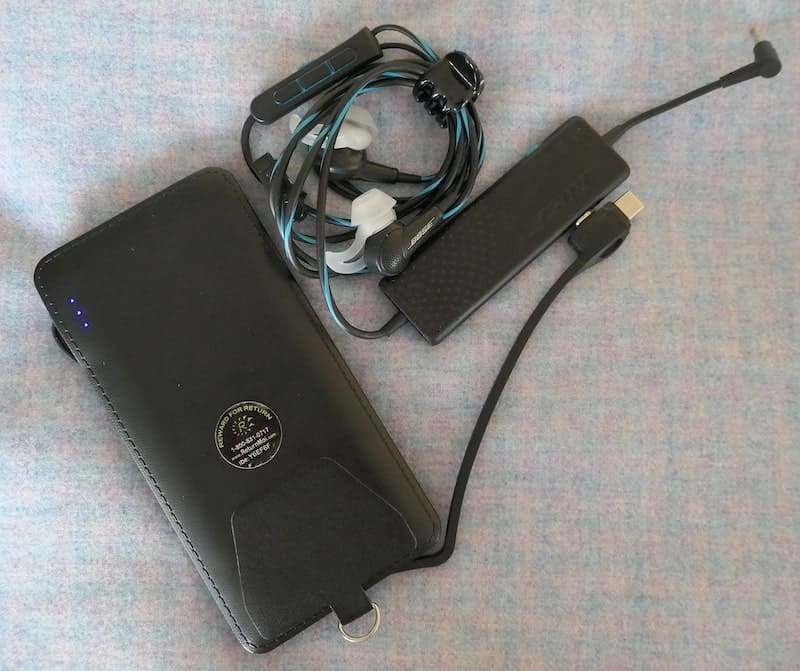 TG90 Power Bank and Bose QC 20
- Hiking, camping, and staying in accommodation without power is another consideration. On a trip that included a hike on New Zealand’s Banks Peninsula Track, one of the overnight huts was without power. Before that trip, I replaced my Anker 3200 mAh Astro Mini, a ‘lipstick charger,’ with the Jackery Bolt 6,000 mAh unit.
- With the constant changes and improvements in the technology space, I now travel with a TG90 10,000 mAh portable charger that has earned its keep on many occasions.
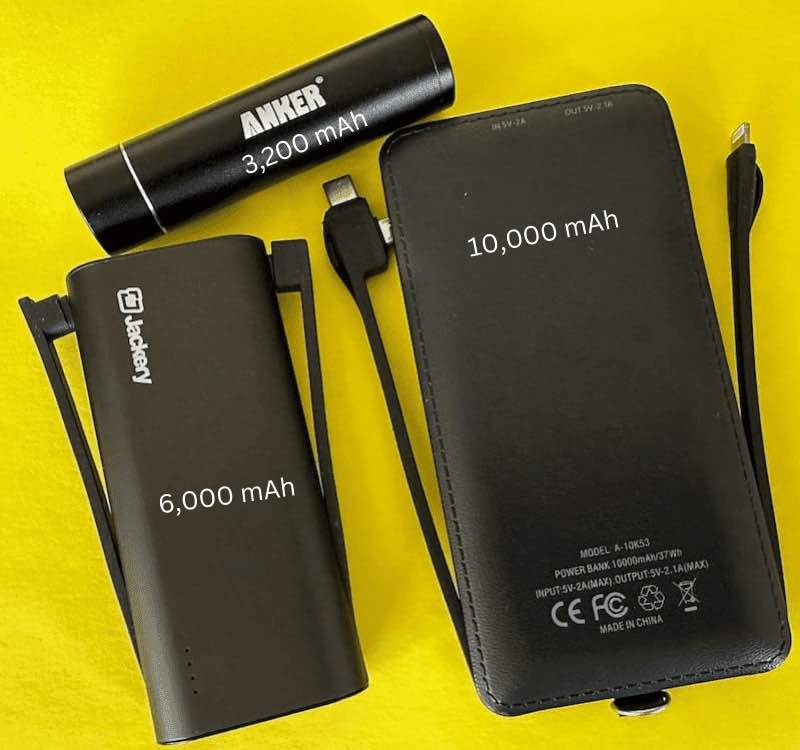
Review of the TG90 10,000 mAh portable power bank
I like the versatility of a 10,000 mAh external charger, especially one with built-in charging cords capable of charging more than one device at a time. Today’s 10,000-mAh units are more compact and lightweight than their predecessors.
- With the ability to charge my phone up to three times on a single charge, it covers scenarios that include long-haul travel, camping, hiking, and situations where AC power is expected but doesn’t exist or isn’t working.
- The built-in lightning, USB-C, and micro-USB cables mean not having to deal with cable clutter. When not in use, they insert securely into their designated slots and sit flush with the body of the unit.
- I love the slim design and how flexible the built-in charging cords are. The TG90 is almost the same size as my iPhone 14 Pro and the flexible lightning cord permits charging the phone while both are sitting back-to-back in a pocket of my purse.
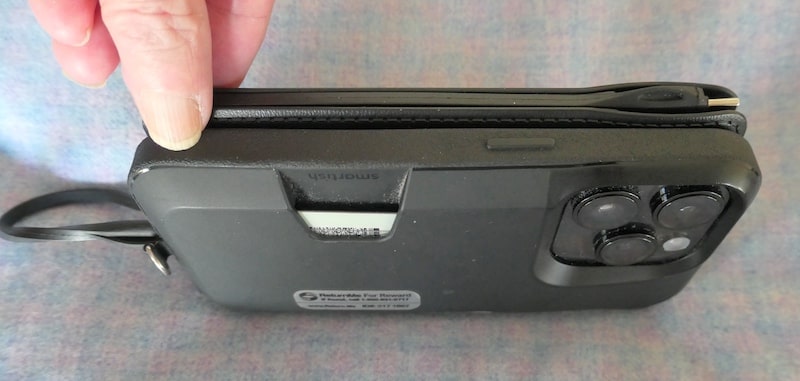
- With the high speed 5V 2.1A maximum output, I can charge three compatible devices at the same time using the three built-in cables. There’s an additional USB-A and USB-C input/output port at the top of the unit.
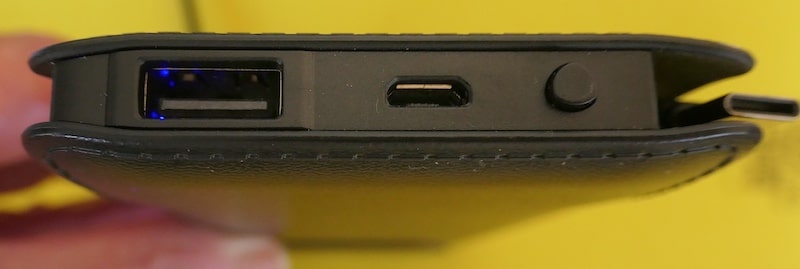
- It comes with a twelve-month warranty and claims of 500+ recharge cycles over the life of the battery. A short (12 in / 30 cm) micro-USB to USB-A charging cable to charge the TG90 is included. There’s no charging block so a USB-A to AC charging source is needed. My Lencent USB to AC charger with international adapters is packed for all trips.
- It’s handy to have the 10,000 mAh capacity printed on the cover along with the safety symbols. This is helpful in the event the capacity is questioned during security screening prior to a flight.
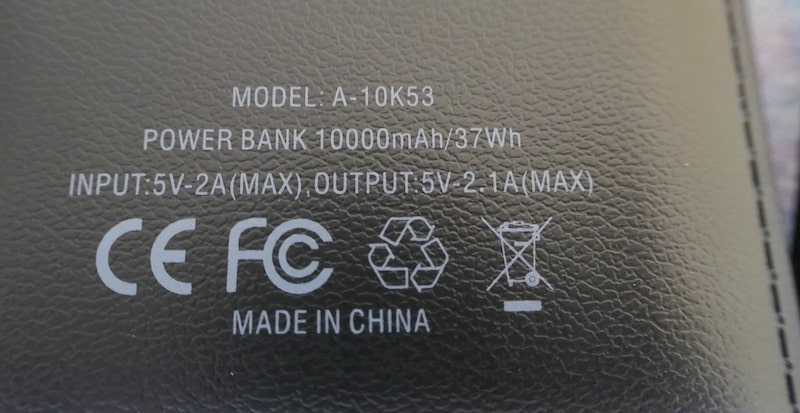
- The build quality is excellent and the integrated cables are durable. They’ve held up very well so far. The cover feels and looks like quality leather and easily accommodates an adhesive tether tab and a lost-and-found sticker.
- It measures 5.71 x 3.13 x 0.58 inches (14.5 x 8 x 1.5 centimetres) and weighs 7.4 ounces (209.79 grams) so it can be easily carried in a pocket, purse, or day bag.
Conclusion
The reality is that there are times when having a charged phone is not just convenient, but a necessity. When a phone’s battery is approaching zero, who needs to interrupt travel plans to search for a power outlet?
Whether heading into the bush, hopping on a train, or pounding city streets in a foreign land, in this day and age a travel-friendly portable power bank is a very useful travel aid.
Might you be interested in these related posts?
- Pack light with a USB to AC international travel charger
- Roamless review: 11 Reasons to buy a flexible Roamless eSIM plan for travel
If you found this post helpful, please share it by choosing one or more social media buttons. What about you? Do you travel with a travel-friendly external power pack? If so, what is your favourite? Please join the conversation in the comments. Thank you.
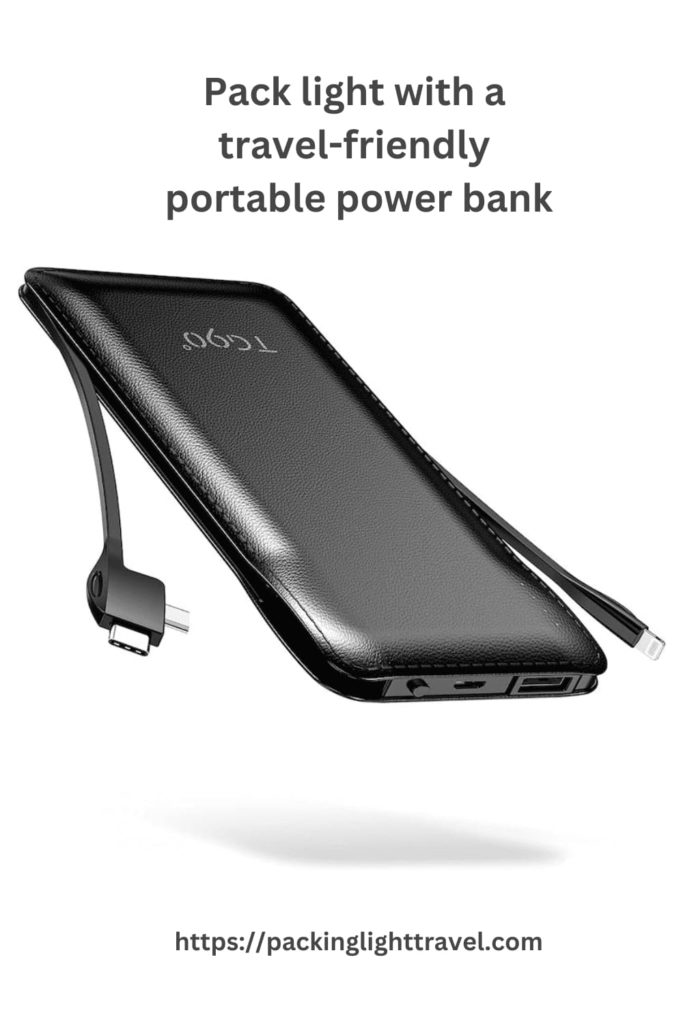
Pin for later?
The Amazon links are affiliate links. This means that if you buy something after clicking on a link, Packing Light Travel earns a small commission, at no additional cost to you. It helps support the costs of maintaining the site, so thank you.




Thanks Anne. I looked into those a few years ago and decided it wasn’t worth it. Based on this article, they obviously have made a lot of progress. I might get one for my next trip.
Thanks for your comment, Mado. If you rely on your devices, they’re worth investigating. You’ll notice many improvements since you last looked into it. The Bolt turned out to be invaluable on a recent visit to San Francisco. We were three friends with unlimited use transit passes that helped us get around the city. Between Google Maps and needing to show our transit passes (on our phones) on demand, the Bolt kept our phones topped up.
The security person at either Halifax or Toronto asked if I had an external power pack and said I would be unable to board, if so, is that for real or only a power trip? I didn’t so that was the end of it. Just wondering before buying one!
Thank you for your question, Joan. The prevailing Intel points to being able to pack the vast majority of external power packs (100 Wh or less) in carry-on bags. For more information, look up CATSA and TSA sites for restrictions on carrying batteries. External power packs are marketed by their milliampere hours (mAh). For some idea of how Wh compares to mAh, a 16750mAh battery is equivalent to 61.98Wh. A 32000mAh unit converts to 118.4Wh. While information from national security screening agencies is useful, to be absolutely certain it wouldn’t hurt to check the sites of the airlines on your itinerary.
Oh these are so useful. We did a lot of research and bought a big fancy one (can’t remember the name). In the end we bought another one at a random market in Bangkok which works like a charm!
These are crucial for travel! We actually love the one we got at a dodgy market in Bangkok, but I imagine this one is even better!
Personally, I think power banks are essential when traveling or even out for an extended time. With how many gadgets my family has they always come in handy.
I have always wondered if somebody that is used to power banks can do without one, especially when travelling. I don’t use power banks and i don’t travel much either. I guess if one is to travel and there is no access to a power source, a power bank will be crucial. But there are power sources almost everywhere so why the need for power banks. but, and this is a big but. if the talk time on one’s phone is much then the need for a power bank is crucial. because that is what drains the battery the most.
Absolutely! A portable power bank is a travel essential. It keeps your devices charged on the go, ensuring you’re always ready for navigation, photos, or any unexpected situations. Highly recommended for peace of mind!
Because of safety concerns, there are restrictions on carrying and using battery packs on aircraft.
The maximum capacity allowable is 100 watt hours (about 27,000 mAh). Batteries between 100Wh and 160 Wh requires airline permission.
Many airlines now require battery packs to be carried on you or in your personal item under the seat. Battery packs are not to be kept in the overhead bin.
And many airlines now prohibit the use of battery packs during flight to recharge devices, and also do not allow battery packs to be recharged during flight. So charge your devices before getting on the plane.
And recently when travelling through Brisbane security was checking that passenger had no more than 2 battery packs.
Another restriction is that if travelling by air in China, your battery packs must contain the “CCC” marking or they will be confiscated.
Thank you, John for the information. Very helpful.