

Updated April 14, 2026
After purchasing fixed plans from other eSIM providers, I was attracted to the many appealing features of the flexible pay-as-you-go plan offered by Roamless. Here is my review, highlighting several reasons to buy a flexible Roamless eSIM plan for travel.
Roamless offers both fixed and flexible plans (RoamlessFix and RoamlessFlex). My review is of RoamlessFlex.
Table of Contents
- A few basics
- Roamless offers two pricing models
- 14 Reasons to buy a flexible Roamless eSIM plan for travel
- 1. An eSIM that never expires
- 2. A single global eSIM connects in every country
- 3. Simplified settings with a single global eSIM
- 4. Rollover of unused data
- 5. No need to estimate how much data to buy
- 6. RoamlessFlex has outgoing calling capabilities
- 7. Roamless now offers RoamlessNumbers
- 8. Use WhatsApp or Messenger from anywhere
- 9. Funds in a Roamless wallet don’t expire
- 10. Roamless offers frequent discounts
- 11. Cost of data varies by destination
- 12. Sign up using a referral or promotional offer
- 13. Coverage and speeds are excellent
- 14. User-friendly app
- Conclusion
A few basics
Firstly, let’s review a few basics about being connected to the internet while travelling.
1. What is an eSIM?
Unlike a physical SIM card, an eSIM, or embedded SIM, is a digital product allowing access to the internet using cellular/mobile networks (as opposed to Wi-Fi networks). Most eSIM providers sell ‘fixed plans’ with a fixed amount of data for a fixed number of days for a fixed price.
Plans vary by destination. Typically, a local plan is valid in a specific country (e.g., Zambia), a regional plan covers select countries in a particular region (e.g., Africa), and a global plan offers coverage in as many as 200 select countries across the globe where the eSIM provider offers coverage.
And finally, some plans include calling capabilities, but fixed data plans without global calling are more common.
2. Reasons to NOT rely exclusively on Wi-Fi
Accessing the internet requires data via a Wi-Fi connection or a cellular/mobile connection. Without some form of data connection, a device cannot communicate with the internet.
Wi-Fi connections require a device such as a phone or tablet to be located near a router. This is typically measured in feet or metres. Cellular/mobile data is accessed through the nearest cellular tower, typically measured in miles or kilometres between a device and a tower.
Free Wi-Fi is available in transportation hubs, at hotels and other forms of accommodation, and in many establishments such as restaurants and coffee shops. However, most Wi-Fi hotspots aren’t secure, and a device is susceptible to hackers who can access sensitive information such as passwords and financial information. On the other hand, cellular/mobile networks are managed by telecommunication companies that have invested in security measures to protect their infrastructure and user data.
Wi-Fi is a short-range option. Once a traveller is out of range of the Wi-Fi network, an internet connection is lost. This means that access to platforms such as WhatsApp or Messenger, navigation aids such as Google Maps, ride-sharing services such as Uber, social media, email, banking, and internet-based research and information is no longer possible.
Booking and paying for travel, dealing with emergencies or the unexpected, staying connected with family and friends, locating points of interest, sharing the travel experience with others, and looking up information on the fly are all possible with an internet connection.
Staying connected is a matter of safety and convenience. Having an internet connection enhances a travel experience.
3. Limitations of WhatsApp and Messenger
Apps such as WhatsApp and Messenger have become indispensable tools for travellers as they offer a cost-effective means to communicate with others.
- As VoIP (Voice over Internet Protocol) apps, both parties require an internet connection via Wi-Fi or a cellular/mobile network to make or receive an audio or video call.
- Both parties must have the respective app (i.e., WhatsApp or Messenger).
- With the exception of travel providers, very few businesses use these platforms.
Roamless offers two pricing models
Like most other eSIM providers, Roamless offers a fixed plan called RoamlessFix. Plans have a specified amount of data, a fixed validity period of 30 days, and coverage in a particular country or region. These plans offer cheaper per-gigabyte (GB) rates for more affordable data usage.
Unlike most other eSIM providers, Roamless offers a flexible pay-as-you-go plan called RoamlessFlex. It is this plan that captured my interest and is the subject of my review.
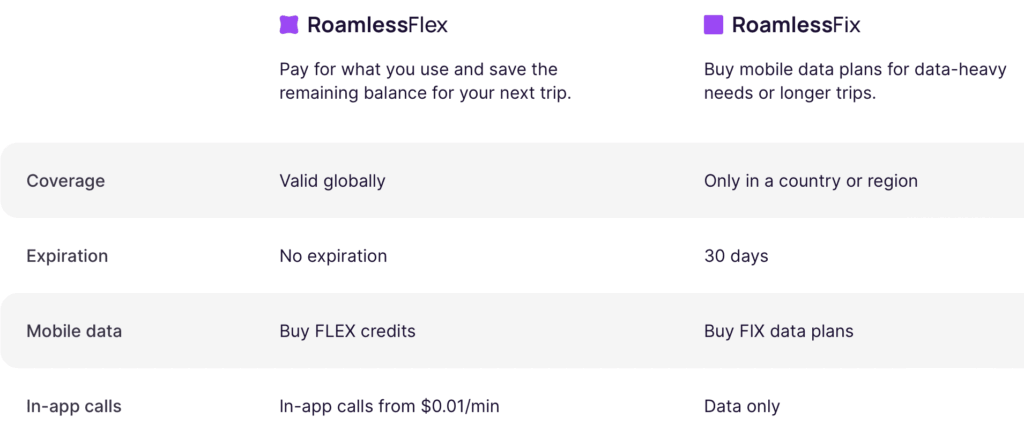 Image credit: Roamless
14 Reasons to buy a flexible Roamless eSIM plan for travel
For a 30-day trip to Europe in the summer of 2025, I purchased a RoamlessFlex plan, and I couldn’t be more pleased with the results. Using the same plan for a 48-day trip to Asia in October and November of 2025 reinforced my faith in Roamless and the RoamlessFlex plan. In the spring of 2026, the plan worked flawlessly on a 28-day visit to Portugal.
1. An eSIM that never expires
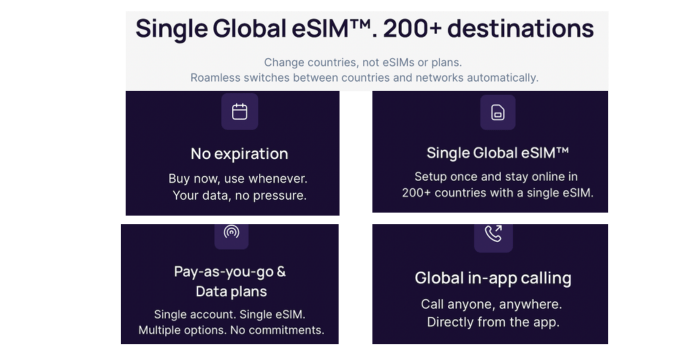
Roamless offers a single, global eSIM that automatically works in over 200 countries. Once it’s activated, it works in every country with Roamless partner networks. Installing, switching, and deleting expired eSIMs is not part of the Roamless landscape. My Roamless eSIM is activated once and comes with lifetime usage. It stays on my Roamless account without the need to remove it.
Note: FLEX and FIX plans both use the same Roamless global eSIM. If a user has both plans, there’s no need to install two eSIMs. Roamless auto-detects the location and uses the better option for the user in real time.
2. A single global eSIM connects in every country
Many competitors in the eSIM market specialise in location-based plans covering a particular country or region.
On a trip to Africa via New York and Istanbul in 2023, I purchased a global eSIM from Airalo with coverage in 137 countries. Unfortunately, one country on my itinerary, Zambia, wasn’t among the 137. However, it was among the 200 countries for which local eSIMs were available from Airalo. If I wanted cellular/mobile coverage in Zambia, I needed to purchase a local plan for Zambia, which I did. Switching between the two eSIMs proved to be costly and inconvenient.
My Roamless eSIM is not country or region-specific. It automatically connects to one of the Roamless partner networks in over 200 countries. This simplifies matters when I’m travelling to several countries with varying data requirements and timeframes.
Also, if I upgrade my phone, I can delete my Roamless eSIM from my old device and reactivate it on my new device. My Roamless wallet balance becomes usable on my new device immediately after the eSIM transfer.
3. Simplified settings with a single global eSIM
When I started my eSIM journey, my iPhone’s Cellular > SIMs settings included ‘Primary,’ ‘Secondary,’ ”Personal,’ and ‘Travel.’ For someone new to the world if eSIMs, having so many lines was confusing. With one Roamless global eSIM labelled ‘Roamless,’ switching between my Primary and Roamless lines is efficient and uncomplicated.
My ‘Primary’ line connects to my Canadian telephone number attached to the physical SIM card of my home-based carrier (Rogers). I don’t need to remove the physical card to use my Roamless eSIM.
Switching between the two lines not only makes activating my Roamless eSIM a simple process when arriving at a new destination, but receiving a 2FA (Two-Factor Authentication) text is seamless. Because incoming texts are free, receiving a text is a simple process of temporarily switching from my Roamless line to my Primary line, receiving the 2FA code, then switching back to the Roamless line. Doing so incurs no roaming charges of my home-based carrier.
4. Rollover of unused data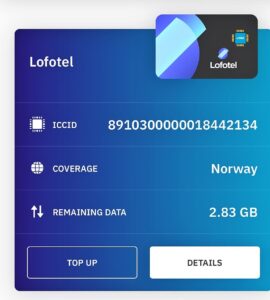
On a trip to Norway in 2024, I purchased a 30-day plan from Airalo with 5 GB of data. When the 30-day plan expired, the 2.83 GB of unused data disappeared with the plan.
Most competitors impose fixed validity periods. They’re invariably available for 7 days, 15 days, or 30 days, which may or may not align with the length of a trip. When a trip lasted three weeks, I bought a 30-day plan. For my 46-day trip to Africa, I had a 60-day plan. Both options resulted in paying for days of service I didn’t need.
5. No need to estimate how much data to buy
Estimating how much data to purchase can be difficult. How much free Wi-Fi will be available? On how many occasions will cellular/mobile networks be the only option? Will 1 GB be sufficient, or should I purchase a plan with 2 GB, 3 GB, 5 GB, or more?
Many travellers with cellular/mobile coverage use free Wi-Fi where it’s available. That is my practice. On a 28-day trip to Portugal in 2026, had I purchased a fixed plan, I might have opted to buy 10 GB of data. However, I used only 4.7 GB, saving money in the process.
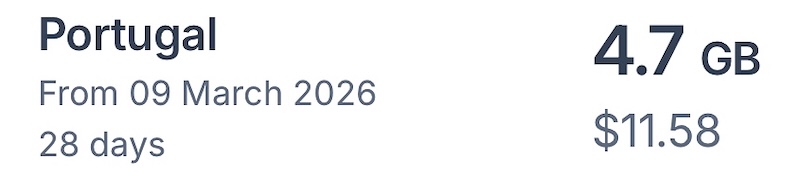
With my pay-as-you-go RoamlessFlex plan with rollover of unused data, I can track cellular/mobile data usage in real time in the Roamless app. In addition, the ‘Trip Summaries’ feature displays data usage by trip, destination, and dates.
Yes, the data costs a little more with a RoamlessFlex plan, but with the frequent discounts offered by Roamless, I take advantage of these to top up my account at discounted rates. l appreciate not having to estimate how much data I’ll need before each trip, commit to a plan upfront, purchase additional data if I need more, or see unused data or days disappear at the end of the fixed period.
With the ‘pay-as-you-go’ model of the RoamlessFlex plan, the unused data in my account rolls over to my next trip.
6. RoamlessFlex has outgoing calling capabilities
The importance of having reliable voice call capabilities is a matter of security and convenience. While I rely on my Fongo VoIP app and Canadian Fongo number to make and receive free calls to and from Canada, being able to make local or international calls is convenient. During my European trip, I needed to let a friend in the UK know I had just boarded a train so she could collect me at her home station 30 minutes later.
Having outgoing calling capabilities is also helpful for confirming a tour meeting point, calling a hotel to arrange an airport pickup, making a restaurant reservation, calling my bank in Canada, or a multitude of other scenarios.
Most fixed plans don’t support outgoing calls. RoamlessFlex has a built-in VoIP calling feature, allowing calls to over 200 countries from within the Roamless app. Rates are cheap, starting at $0.01/minute. Roamless in-app calls work with Wi-Fi or cellular/mobile data.
Making a call is easy with RoamlessFlex. Allow the Roamless app to access your contacts, select the number, and make the call.
NOTE: The call display feature at the destination may indicate it’s from New York. That was my friend’s experience in the UK who was expecting my call and thankfully answered it.
7. Roamless now offers RoamlessNumbers
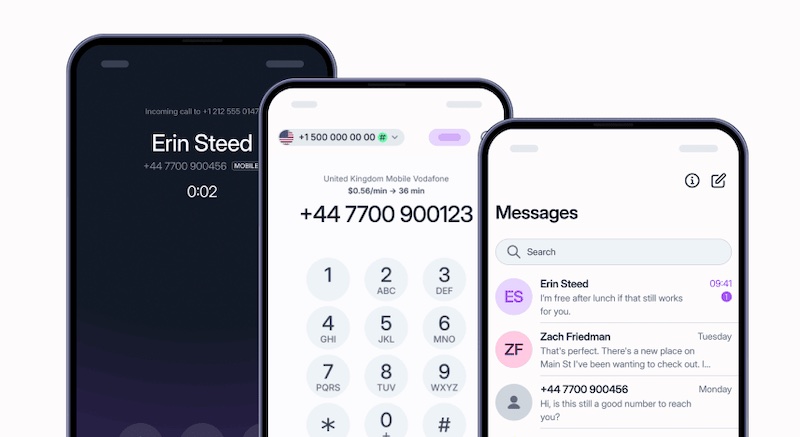
Roamless has recently released a feature called RoamlessNumbers with caller ID and the ability to make and receive calls (incoming calls are free), and send and receive text messages. Any Roamless user, anywhere in the world, can purchase a Roamless Number, with three country codes offered in the initial rollout (Australia, Canada, and the UK).
The cost to obtain a Roamless Number is $6.95 per month or $59.45 per year. Outgoing calls are charged by the minute, according to the country being called (typically, between $0.01 and $0.05). Roamless Numbers use VoIP, work from inside the Roamless app, and need data connectivity to function.
8. Use WhatsApp or Messenger from anywhere
Inbound and outbound calling over VoIP is possible with platforms such as WhatsApp or Messenger as long as the device has an internet connection via Wi-Fi or a cellular/mobile network. With a Roamless eSIM and data plan (fixed or flexible), you have a connection to a cellular/mobile network. This makes it easier to connect with loved ones at home when you’re out and about. I’ll often make a WhatsApp video call to my partner back in Canada to share my location and surroundings with him.
9. Funds in a Roamless wallet don’t expire
With the RoamlessFlex pay-as-you-go model, I can add funds to my virtual wallet for use in any covered country. I can also make in-app calls using funds in my Roamless wallet.
I can add as little or as much as I like. My credits remain in my wallet for my next trip, in a month, a year, or beyond.
10. Roamless offers frequent discounts
As a Roamless account holder, I receive promotional notifications offering top-ups at discounted rates. While data costs are higher with RoamlessFlex, they aren’t if a user takes advantage of promotional offers to top up an account. When Roamless offers a a 25% discount on all travel data, I’m likely to take advantage of it. This makes the higher cost of data with a RoamlessFlex plan more affordable than most fixed-data plans on the market.
11. Cost of data varies by destination
Pricing differs by destination, and data costs are higher with RoamlessFlex. For example, 1GB might use $2.45 of funds in my Roamless wallet in one country (e.g., Portugal), but more in another.
With multiple countries on an itinerary, I’m paying for the convenience of having an eSIM that never expires, and connects to a partner network every time I cross a border.
12. Sign up using a referral or promotional offer
Roamless account holders have a unique referral code that earns a $5 credit for both the referrer and the person using the code to sign up for a Roamless account. Mine is ANNEFITL.
However, it may be more beneficial to sign up using a promotional offer from Roamless or one of its affiliates. I signed up for a ‘spend-$15-get-$15’ offer using the code HELLO15 in the summer of 2025. Credits from promotional codes expire, so they are always consumed ahead of other funds in a Roamless wallet.

13. Coverage and speeds are excellent
I watched a few YouTube videos and printed off the instructions on installation and activation. If your experience is anything like mine, I was surprised when my eSIM installed itself with a single-click iOS setup process on my iPhone 14 Pro.
When I arrive in a new country, connecting to a cellular network is a simple matter of following the instructions from Roamless and I have a connection before reaching the terminal.
Throughout my trips, coverage has been excellent, even in mountainous regions in Switzerland and northern Italy. I have access to 5G where it’s available with no throttling of data speeds. Roamless guarantees full-speed data for the duration of all RoamlessFlex or RoamlessFix plans with high-speed connectivity and unlimited hotspot/tethering.
14. User-friendly app
The Roamless app is functional, with a user-friendly interface. I can check the remaining funds in my Roamless wallet, track data usage by country and trip, add credits at any time, and make in-app global calls.
Conclusion
I love having just one eSIM that never expires, and unused data that rolls over to my next trip – rarities in the world of eSIMs. Connectivity, coverage, calling capabilities, affordability, hotspot connections to my tablet, and ease of use have made RoamlessFlex my eSIM plan of choice for most future trips.
With one eSIM for Roamless fixed and flexible plans, for month-long trips to a single destination, I may choose a RoamlessFix plan with data rates that are cheaper than those of other providers. For example, for 30-day 5-GB plans for Switzerland:
- Roamless: USD 10.95
- Saily: USD 13.99
- Airalo CAD 20 / USD 14.77
For longer trips to Australia, I’m torn on whether or not I’ll continue my practice of buying a physical SIM card and plan upon arrival. On my last visit in early 2025, a 28-day plan from Vodafone cost AUD 25 (USD 16). It included 55 GB of data, unlimited country-wide calls and texts, and calling capabilities to select countries. It offers the convenience of a local number for making and receiving calls. However, one inconvenience is that receiving a 2FA text to my Canadian number involves removing my Australian SIM card and temporarily inserting the Canadian SIM card of my home-based carrier. For more information, see Buying a SIM card in Australia.
For trips to Australia, one thing is certain: I’ll have my RoamlessFlex plan as a back up in any area without Vodafone partner networks, I’ll switch to my RoamlessFlex plan with connections to the Telstra network that has the best coverage in Australia. Unfortunately, Telstra doesn’t have a presence at airports and purchasing a Telstra plan isn’t easy for visitors.
If you found this post helpful, please share it by selecting one or more social media buttons. Have you used a Roamless eSIM plan? If so, what was your experience? If not, what is your current eSIM provider of choice, and what are its appealing features? Please add your thoughts in the comments. Thank you.
Care to pin it for later?




Excellent information Anne. I currently use Airlo when travelling. My challenge with them is I often have to buy more gigabytes before the end of my trip. So if I understand you correctly. I can just buy Roamless as my eSIM provider … and remove Airlo? Or will Airlo have to remain on my phone but unused?
Hi Donna, nice to hear from you. Yes, you could switch to Roamless as as your eSIM provider and choose from either or both of their plans: fixed or flexible. I chose flexible for my last trip but I may add a fixed 30-day plan for 30-day trips to a single country or region in future. My flexible plan never expires and unused data from my last trip is available for future trips. Both plans work side by side and Roamless chooses which plan is to my advantage in real time.
I removed my Airalo eSIMs because they had all expired. They were all associated with fixed plans (fixed periods of validity such as 60 days for Africa, 30 days for Norway) and any unused data disappeared upon expiry. My new Roamless eSIM has lifetime usage so it will be the only eSIM on my phone going forward.
Given your tendency is to buy more GB before the end of each trip, take a look at RoamlessFix (their fixed plans of 30 days) to a single country or region. The data rates are cheaper (cheaper then their RoamlessFlex plan and from my research, cheaper than other eSIM providers). The same global Roamless eSIM works for both their fixed plans and flexible plans. However, any unused data won’t roll over and the fixed plans don’t have outgoing calling capabilities.
More information than you likely need. Thank you for reading the post and I hope it was useful Where are you off to next?
Excellent article Anne! My partner was checking it out as soon as I forwarded this to him. Thanks for sharing your experience and knowledge!
Will I still have access to my own phone number unlike when I replace my physical Sim card with one for travel?
What is your purpose for switching to your home-country number? To receive a text from your bank or other 2FA? Yes, just switch to your primary line then switch back to the Roamless line. Does this answer your question?
How does the esim stop working & your regular sim card work when you return home?
Just switch to your primary line (in my case, to my physical SIM card attached to my home provider).
Anne I did not use Roamless but plan to next time I need a card. Sounds good. We had a great trip along the Camino. Look forward to hearing about your next adventure.
I have used Roamless Flex on 2 trips now covering various countries in SEA. Love that I don’t lose the remaining data at the end of the trip. Great review Ann
Thank you, this was very useful information as I plan to go to Asia next spring. And I have been trying to figure out which eSIM to use. I will definitely check out the Roam flex plan.