
Updated August 17, 2025
While eSIMs are convenient for some destinations, there are occasions when physical SIM cards have advantages over their eSIM counterparts. For extended visits down under, a physical SIM card is my preferred choice and buying a SIM card in Australia is easy and convenient upon arrival. Data and calling plans are affordable, built with travellers’ needs in mind.
Chances are you’ve spent many hours travelling to Australia at considerable cost. It’s a huge country, and you’re likely staying a while. Relying exclusively on Wi-Fi offers intermittent access to the internet and most eSIM plans don’t have incoming and outgoing calling capabilities. Choosing a physical SIM card and prepaid plan offer the convenience and security of being connected to the internet at all times and the ability to make and receive domestic and international calls.
On my last five trips to Australia, I’ve experimented with Vodafone, Optus, and Amaysim and offer the following recommendations as a result.
Buying a SIM card in Australia
There are lots of choices between networks, sellers, and plans. Choosing the right plan comes down to your circumstances and preferences. If you’re new to the practice of buying a local physical SIM card, start by identifying your needs. Here are some possibilities.
1. Decide between eSIM or physical SIM
Most eSIM plans are data-only plans without the ability to make and receive calls. Access to the internet is via a cellular/mobile network (as opposed to a Wi-Fi network). As long as your device is within range of a cellular/mobile tower of a partner network, you’ll have the ability to check email and social media, research information, make online bookings, or use VoIP (Voice over Internet) apps such as WhatsApp or Messenger.
Physical SIM cards and plans, especially those in Australia, offer loads of data at an affordable price, a local telephone number to make and receive unlimited domestic texts and calls, and calling minutes to select countries.
2. Set up and activate physical SIM at the airport
I like to have a phone connected to a cellular/mobile network before leaving the airport. It allows communications with others, especially when faced with travel delays or to confirm meeting arrangements. Hunting down a SIM card at a downtown location, or encountering difficulties activating your phone interfere with your ability to get on with your travels.
3. Country-wide calling minutes and texts
Booking accommodation and activities, connecting with travelling companions, meeting up with friends, or making emergency calls are easier with a phone connected to a cellular/mobile network.
4. International calls
I appreciate plans with calling minutes to select countries. I’ve come to rely on WhatsApp, but international calling minutes via a cellular/mobile network is a helpful feature for calling businesses that rarely use VoIP apps such as WhatsApp or Messenger. I’ve used my local Australian number and calling minutes to contact my bank, credit card company, and administrator of my emergency medical insurance policy.
5. Loads of data
Most travellers appreciate the convenience of connecting to the Internet at any time. Travel research, VoIP calls, online bookings, navigation, managing email, looking up stuff on the fly, and posting to social media can be accomplished without having to track down Wi-Fi. Or, without being tied to a specific time of day to perform any of these functions. Having enough data allows you to establish a Wi-Fi connection for a tablet or laptop through the hotspot feature on your phone.
On my last trip to Australia in early 2025, a 28-day plan with Vodafone came with a whopping 55 GB of data for AUD 25 (USD 16).
6. Validity period
Most of my stays in Australia are for six weeks to two months. The affordability of feature-rich cellular/mobile plans make signing up for a physical SIM card and local phone number a wise choice.
7. Access to top up
It helps to know which plans permit extensions, allow rollover of unused data or calling minutes, or the ability to purchase additional calling time or data.
8. App to track usage
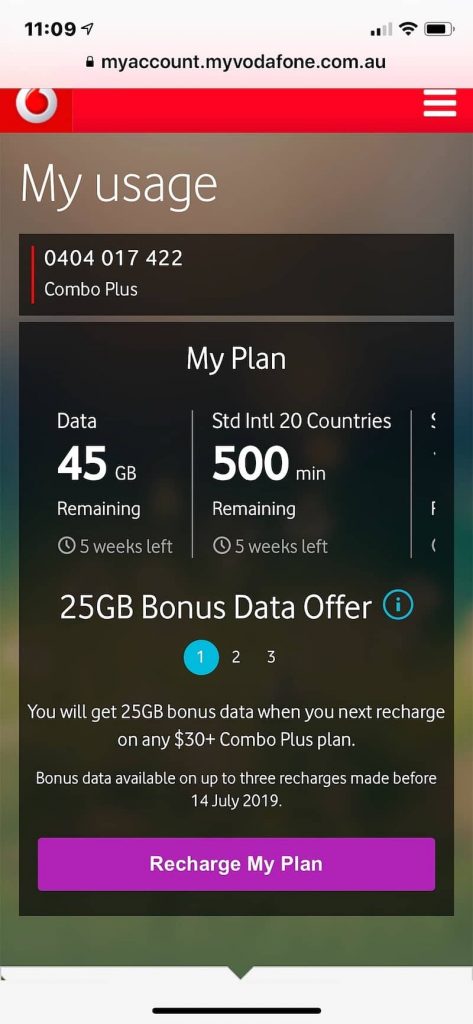
An app takes the guesswork out of figuring what data and calling minutes remain. I find it more convenient than an online account.
Research networks, coverage, sellers, plans, and costs
1. For a list of networks, sellers, and recommendations, start with Buying SIM Cards and eSIMs Around the World at Too Many Adapters.
2. There are three main networks in Australia: Optus, Telstra, and Vodafone. There are several resellers, such as Amaysim, Boost Mobile, and Vaya. Amaysim and Vaya use the Optus network. BoostMobile is powered by Telstra. A quick visit to each site provides the latest information on plans and prices.
3. If you’re planning to spend time outside the major centres, check the network coverage maps. Telstra has the best coverage but the company doesn’t have a presence at airports and makes it difficult for visitors to set up an account.
4. Check which sellers have a presence at your arrival airport, their locations, and hours of service. Your arrival airport website will likely have this information. Travellers who order a SIM card online or buy one at a location other than an airport will have a different approach. Optus and Vodafone have kiosks in most airports with international connections, including the International Terminal of Brisbane Airport.
It pays to do the research
Research online, and then again at the airport. With more than one seller, it’s possible you’ll find discounted rates. This was the case in Sydney in March 2025, when Vodafone charged $25 for a 28-day plan (instead of $35).
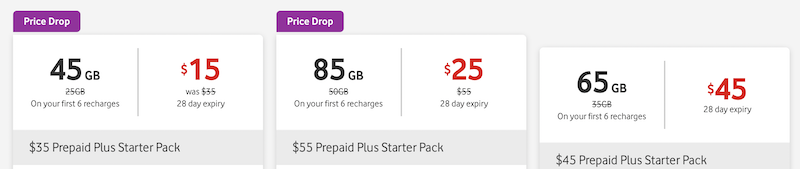
Or, you may find a deal for an online purchase. For example, in July 2024, Vodafone had an online half-price offer on its Prepaid Plus Starter Packs. The $35 Prepaid Plus Starter Pack came with 45 GB of data, unlimited national calls and texts, and 500 international calling minutes to 36 countries for only $15 for 28 days.
My experience with Optus and Vodafone
In 2017, I chose Optus. In 2019, 2023, and 2025, I went with Vodafone. Both had kiosks at my arrival airport and both offered similar plans.
With Vodafone, set up was quick and efficient. Ann, the Vodafone worker, had my phone connected to the network within a few minutes.

Ann removed the New Zealand SIM card from my phone and taped it to the Starter Pack. Attached to the Starter Pack was a handy checklist populated with information such as my new Australian telephone number and MyVodafone URL. It’s appreciated when airport kiosks recognize that travellers arrive jet lagged and don’t always ask the right questions. It’s important to send travellers on their way with the necessary information to check balances or obtain service.
In the last few years, plans have become more robust, oozing with features valued by travellers. They’ve also become cheaper. Optus plans were similar in cost and features to those of Vodafone. Here’s an example of a Vodafone plan purchased on one of my trips:
- regular price of $40 discounted to $20
- validity of 35 days
- unlimited talk and text within Australia
- 45GB of data
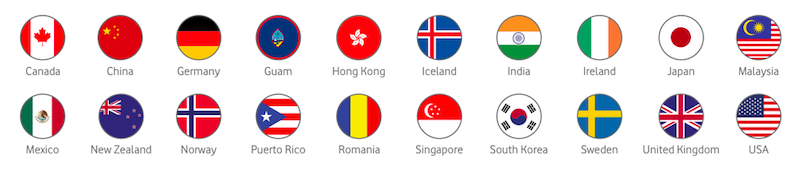
- 500 minutes of international calls to 20 select countries in Zone 1 (Canada, China, Germany, Guam, Hong Kong, Iceland, India, Ireland, Japan, Malaysia, Mexico, New Zealand, Norway, Puerto Rica, Romania, Singapore, South Korea, Sweden, UK, and USA)
- 100 minutes of international calls to 70 select countries (Zone 2)
I found it very useful to have a user-friendly free app to monitor usage and purchase top up.
Both eSIM and physical SIM?
On a trip to Europe in 2025, I used an eSIM and a flexible pay-as-you-go plan from Roamless with pleasing results. It involves a global eSIM with lifetime usage, coverage in 200+ countries, rollover of unused data to the next trip, credits in my virtual wallet that never expire, and the ability to make outgoing international calls. For more information, see my review at 10 Reasons to buy a flexible Roamless eSIM plan for travel.
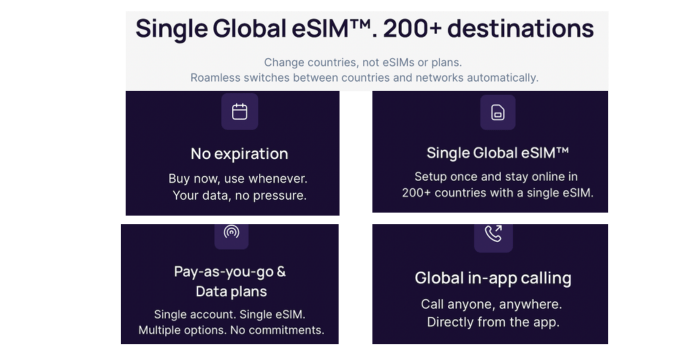
As a result, for my next trip to Australia, I’ll continue my practice of purchasing a physical SIM card on arrival and using my RoamlessFlex plan for those occasional spots where Vodafone or Optus doesn’t have coverage. According to Roamless, Telstra is their partner network.
Conclusion
I was pleased with both Optus and Vodafone. Both make buying a SIM card in Australia easy for travellers. The features were clearly outlined on the websites, and in the information pamphlets at the airport kiosks. Both recognize that passengers arrive at irregular hours, and have staff available to meet incoming flights. Set up is efficient and activation is immediate.
If you found this post helpful, please share it by selecting one or more social media buttons. What’s your experience buying a SIM card in Australia? Please add your thoughts in the comments. Thank you.
Might you be interested in these related posts?
- 10 Reasons to buy a flexible Roamless eSIM plan for travel
- Buying a SIM card in Italy
- Buying a SIM card in Spain
- Buying a SIM card in the USA
Care to pin it for later?




I almost always buy a SIM when traveling.
Australia puts Canada to shame when it comes to rates for data.
We go with Optus, and get 1G/$2/day over $15. You can top it up, you can go over the limit by half each day for an extra $2. Absolutely fantastic compared to home!
Hi Anne,
thank you for sharing your experience. Since you mentioned that for your 2021 trip, you are inclined to go with Telstra here is a page where you can get briefed on their outages
https://internetoutages.com.au/telstra“.
Best,
Olivia
Network coverage is important – Im an Australian resident and have been with telcos that use Optus, Vodafone and Telstra networks. In a trip to the Tasmanian highlands I could not get a signal to book onward travel. Borrowed a phone with Telstra network. Getting back home I switched to Boost which is a cheap provider who uses the full Testra network. I havent had any problems with their prepaid sims. Will use their roaming when overseas next at $3 per day (in 2024)