
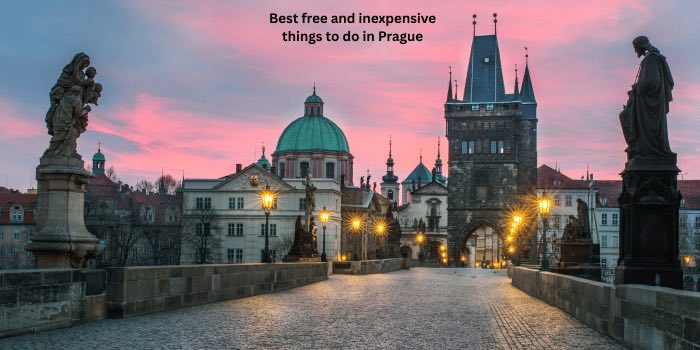
Prague is often hailed as one of Europe’s most beautiful and most budget-friendly capitals. This guide of 33 best free and inexpensive things to do in Prague will steer you through a labyrinth of free gems, affordable experiences, and quirky possibilities while staying within your budget. I have suggestions on where to stay, how to get around, foods to try, and descriptions of many of the sights I enjoyed during my one-week stay.
However, there’s so much more to see, do, and experience in Prague that it demands more than one visit.
Firstly, some tips
- Central Prague is compact and walkable. The best way to explore it is on foot, mixed with public transportation to accommodate energy levels, time constraints, weather, and challenging hills. Become familiar with Google Maps. Another choice is Mapy.cz, a local favourite that works well offline. It offers superior detail for hidden alleys, cycling routes, and colour-coded walking and hiking trails.
- Download apps such as Get Your Guide and Viator for booking tours. Most tours offer generous cancellation policies, instant booking or reserve now, pay later options, and digital ticket storage.
- Check out sites such as Prague City Tourism for a calendar of activities in categories which include performing arts, sports, markets and gourmet, exhibitions, and festivals and celebrations.
- Other valuable resources include the Honest Guide video on YouTube, the Facebook group Prague Travel Tips, and Prague Unlocked 2025-2026: The City of A Hundred Spires Awaits (available in print or digital formats).
- Download the free PID app (PID Lítačka) for using public transportation. The app supports purchasing tickets for the metro, trams, and buses. Users can plan routes, view real-time schedules, and store digital tickets. Seniors aged 65 and over and children aged 0-14 travel for free on public transportation and don’t require a ticket. Travel is half price for those aged 60 to 65. A document such as a passport or other government-issued ID should be carried in case proof of age is required. I was never asked, but it helps to be prepared.
- An unlimited-ride transit pass might make sense for your circumstances. They’re available for 24-hour or 72-hour periods. Priced at 120 CZK (USD 5.77) and 330 CZK (USD 15.88) respectively, it’s an affordable way to explore Prague.
- Download Uber, Bolt, and Liftago apps before leaving home and link your credit card to each account. Ride-sharing apps display upfront fare estimates and accept cashless payments. Avoid random taxis, as there are far too many reports of overcharging, especially from the airport and cabs hanging around busy tourist spots or the central railway station. An exception is booking a fixed-price, official taxi from one of the counters inside the airport terminal.
- For budget-friendly transportation from the airport, consider using public transportation. The Airport Express connects with the central station (Hlavní nádraží), or Bus 100 and Bus 119 connect to metro stations (Nádraží Veleslavín and Zličín, respectively) and is more affordable than a ride-sharing service. Google Maps will show you the way. However, if you’re a group, have a lot of luggage, or are arriving at night, booking an Uber, Bolt, or Lifago will likely be a better choice.
- Another option is a pre-booked private transfer where the driver or another representative meets you in the arrivals area with your name on a sign. These can be booked through your accommodation or online at Welcome Pickups.
- A cellular/mobile plan is indispensable. I use RoamlessFlex to complement free Wi-Fi available in hotels, cafés, malls, the airport, and metro stations.
- Carry coins to access public toilets. Some fast-food establishments in busy tourist areas also charge to use their toilets. Typical costs are 10-20 CZK.
- Obtain cash at an ATM inside a bank. Avoid free-standing ATMs such as Euronet and ATM24, as their conversion fees can be exorbitant. When using credit, debit, or pre-loaded cards, always decline the merchant’s conversion; let your home bank or credit card issuer choose the rate. For ATMs, I use the interest-earning pre-loaded Wealthsimple card with no foreign exchange fees and ATM fees refunded. Wealthsimple is a Canadian company.
- Download a language app with pronunciation features and learn a few basics such as ‘Dobrý den’ (Good day), Ahoy (hi), Prosím (Please), and ‘Děkuji’ (Thank you).
- Avoid eating establishments in key tourist areas. Walking a few blocks from Old Town Square (for example) can lead to much lower prices. Locals tend to make lunch the main meal, so look for ‘Polední menu’ for the best value. The fixed-price, daily lunch special offered by many Czech restaurants from Monday to Friday is usually served between noon and 14:00, featuring affordable, hearty, traditional Czech dishes like goulash or schnitzel with sides, perfect for budget-friendly, authentic dining.
- Beware of pickpockets in crowded areas such as Charles Bridge, Old Town Square, and Tram 22 heading to the Prague Castle. For ideas on anti-pickpocket clothing, bags, and habits, see Stop pickpockets with an assortment of anti-pickpocket gear and 17 Effective tips on protection from pickpockets.
- Check for senior and student discounts. Admission to museums, galleries, and theatres is often discounted.
- Review your in-dining bill. If a service charge hasn’t been added, it’s customary, but not obligatory, to round up with a tip of between five and ten percent.
- Pack comfortable shoes with a decent grip. On summer afternoons, cobblestones heat up and become slippery in wet weather. If you expect to use your phone’s camera and navigational apps, an external battery pack will come in handy.
Where to stay
My budget-friendly suggestion is based on personal experience. For a one-week stay, I chose Aparthotel City 5. The location, proximity to amenities, and stellar reviews make this unpretentious three-star property a winner, ranked #15 out of 659 hotels in Prague on TripAdvisor. It’s a pleasant 20-minute walk to the historic centre along the river, or a short tram ride. The metro station Andel and direct bus service to the airport (Bus 191) are both a four-minute walk away. Its greatest asset is the friendly manager and host Kristina, who offers a satisfying breakfast for a nominal fee and free ‘concierge services’ ripe with tips and recommendations. Rooms are clean, well-equipped with a kitchenette, and reasonably priced.
How to get around
Trams, buses, and the metro use a single ticketing system.
Trams crisscross the historic centre of Prague, and the 24-hour network allows travellers to move between major landmarks like the Prague Castle, Charles Bridge, and Wenceslas Square without changing lines.
Exploring Prague is a breeze with its metro system, known for being quick, affordable, and highly efficient. Launched in 1974, the three-line metro connects long distances across the city. It also covers areas near the central train station and direct bus routes to the airport.
Another convenient option is ride-sharing with Uber, Bolt, or Liftago, offering reliable alternatives to taxis. Keep in mind that with Prague’s historic labyrinth of alleys, squares, courtyards, and one-way streets, a short walk or tram ride may be a better choice.
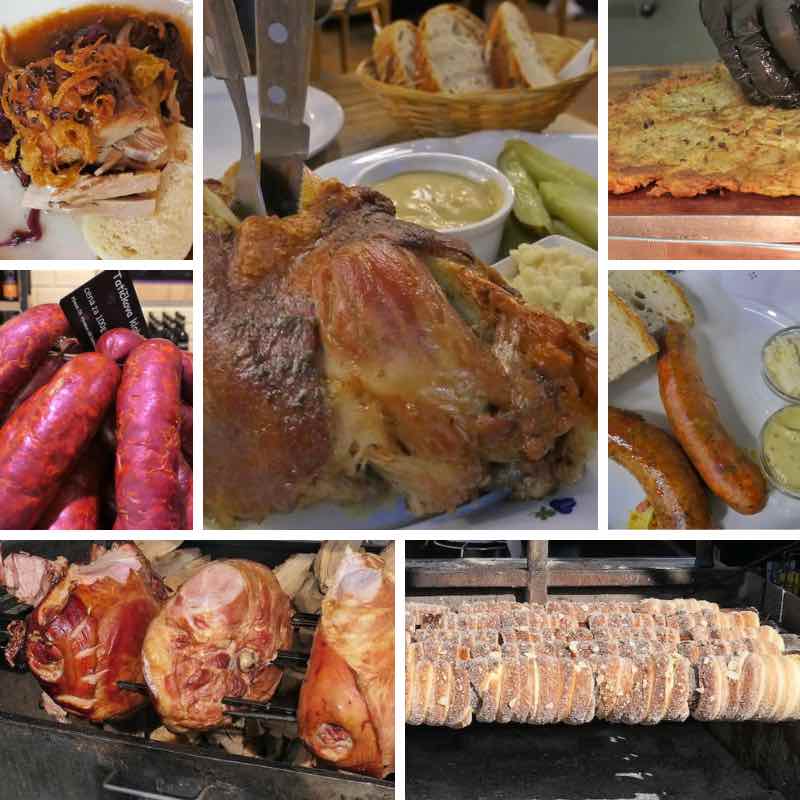
Foods to try in Prague
- Roast Pork Knuckle (Vepřové koleno) is a classic, hearty Czech dish featuring a large pork hock or knuckle slow-roasted until the meat is tender and falls off the bone, with a crispy, golden-brown skin. It’s a very popular pub dish, typically served on a wooden board with a large knife or fork stuck into it for presentation. Accompaniments usually include fresh bread, mustard, horseradish, and pickled vegetables or sauerkraut.
- Old Prague Ham (Pražská Šunka) refers to large hams or pork legs roasted whole on spits over open flames, a common sight at street food stalls. The vendor typically carves slices of the ham directly from the spit, which are then served on a plate or in a bun.
- Farms tended to be small, around five acres, so roast or smoked duck occupied a prominent place in traditional Czech cuisine. I enjoyed smoked duck topped with cabbage and onion, and dumplings on the side.
- Czech sausages (Klobása) are considered a staple in traditional Czech cuisine. They’re a popular fast food, a typical snack, an inexpensive, flavourful meal, and a perfect accompaniment to beer. Outside the main tourist areas, sausages and a half-litre of beer cost about 150 CZK (7 USD).
- Potato pancakes (Bramboráčky) are an integral part of traditional Czech cuisine. They’re a classic, comforting dish made from grated potatoes, eggs, flour, garlic, and spices, often served hot with mustard or sour cream, or as a side to meat dishes.
- For a wide selection of cold cuts, dried meats, cheeses, artisan breads, potato pancakes, pastries, plus Czech beer and wines, visit a delicatessen in Prague to assemble a perfect picnic or tasty snack.
- The popular street food, Trdelnik, is also known as chimney cake. It’s a traditional pastry made from sweet yeast dough coated with sugar and other ingredients such as cinnamon or nuts, wrapped around a spit or wooden stick, and roasted over an open flame. The process gives it a crispy exterior and a soft interior. It can be enjoyed plain or filled with ice cream, chocolate, or fruit.
33 Best free and inexpensive things to do in Prague
Unlike many other European cities, Prague escaped most of the devastation of the Second World War. As a result, it has one of the largest intact historic centres, earning inscription on the UNESCO World Heritage Sites list in 1992.
The majority of the following suggestions are within four key districts: Old Town (Staré Město), Lesser Town (Malá Strana), New Town (Nové Město), and the Castle District (Hradčany). Most are grouped by district, making it easier to plan travel in and between districts.
1. Sign up for a free (tip-based) walking tour
A walking tour can be an ideal way to be introduced to a city’s history, culture, architecture, and location of key attractions. Free (tip-based) tours are offered by a host of companies such as GuruWalk, Free Walking Tour Prague, 100 Spires City Tours, Talkative, and Prague Pulse.
For example, the three-hour Prague ‘free’ tour by Sandeman’s meets daily in Old Town Square, and finishes at Jan Palach Square. It includes the Rudolfinum, the Jewish Quarter, the Astronomical Clock, Wenceslas Square, and the site of the World War II Prague uprising. The local guide weaves Prague’s fascinating history throughout… from Bohemian times to the dark days of Nazi occupation, the assassination of Reinhard Heydrich, life behind the Iron Curtain in the Cold War era, and the fall of the communist state with the 1989 Velvet Revolution.
Themed tours, both ‘free’ and paid, include tours of specific sites, literary and historical tours, audio tours, food tours, and underground tours.
2. Use the tram network
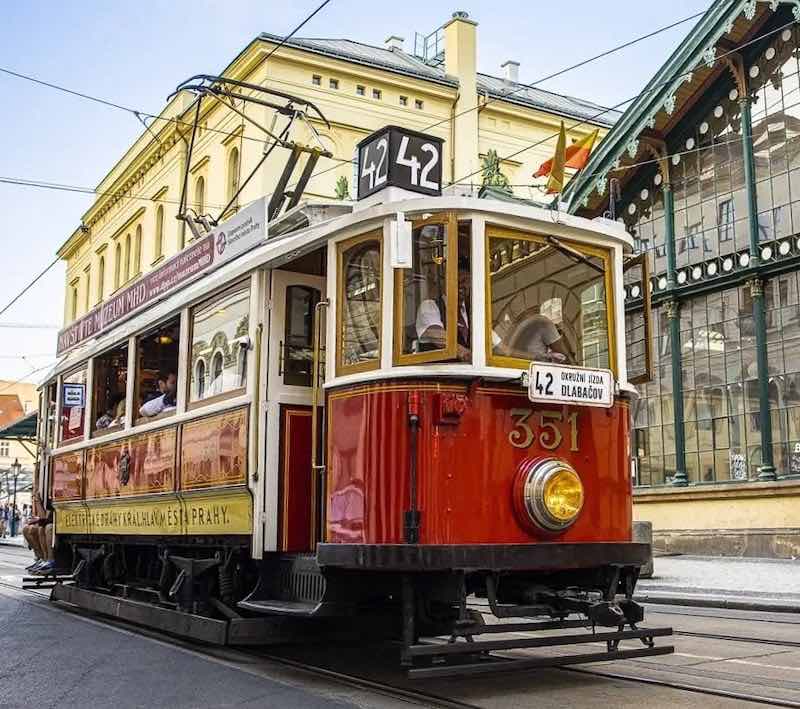
Trams are an integral part of the city’s character and identity, with the network dating back to 1875. Trams are not just a way to get around; they’re the city’s cheapest tour service. Tram 22’s scenic route serves the National Theatre and Prague Castle, making it a favourite among travellers. Tram 17 follows a picturesque river route past Charles Bridge.
For a vintage tram experience on a wooden tram from the early 1900s, Historic Tram Line 41 follows a scenic circular route, taking about 45 minutes with plenty of stops along the way.
3. Visit Old Town Square
Despite Prague’s history of invasions, the Old Town Square (Staromĕstské Námĕstí) has remained relatively untouched since the 10th century. The immense, open square is flanked by magnificently painted house facades, the Astronomical Clock, an art museum, restaurants, and the Gothic Tyn Church, built in 1256. The square is a perfect place to admire the incredible architecture Prague has to offer while being entertained by the street performers, musicians, and merchants.
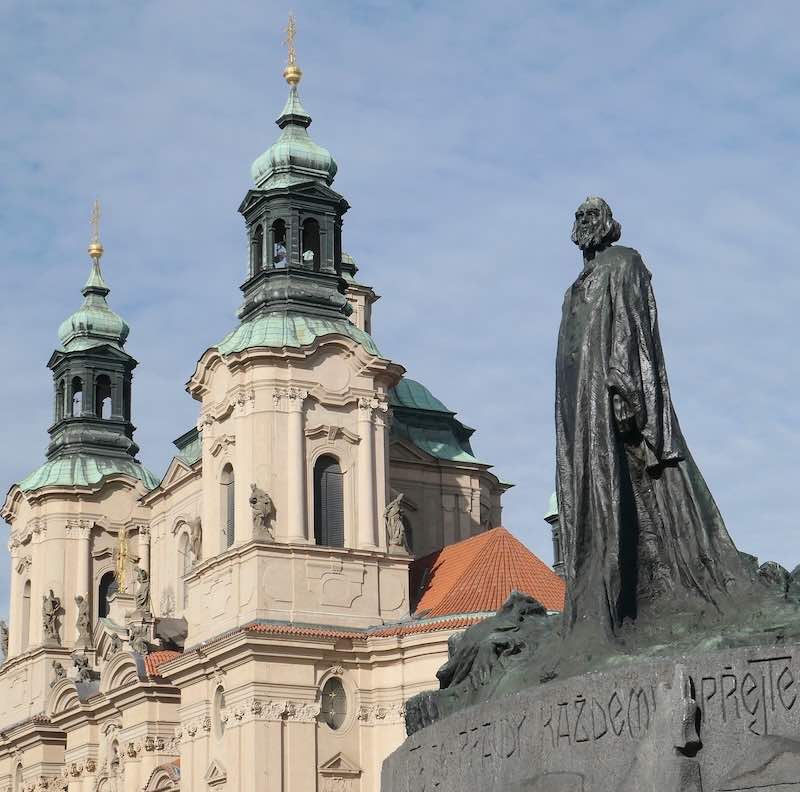
4. Meet at the Jan Hus Memorial
The Jan Hus Memorial is a common meeting place, visible from every part of the Old Town Square.
The memorial honours Jan Hus, the Czech reformer who was burned at the stake in 1415 for his beliefs and teachings. He argued that the Bible, not the Pope or councils, held the highest authority, a direct challenge to the Catholic hierarchy. He advocated for the Scriptures and church services to be delivered in Czech (rather than Latin), the language of the masses.
5. Admire the Astronomical Clock on the hour
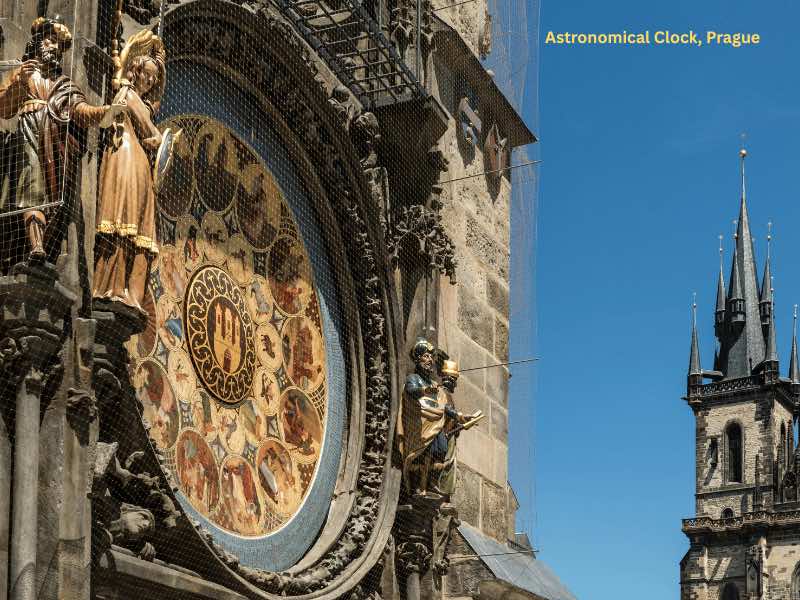
The stunning Astronomical Clock (Pražský orloj) graces the south face of the old town hall in the Old Town Square. It was first installed in 1410, making it the world’s third-oldest astronomical clock and the only one still operating today. Crowds gather daily to watch the dials turn and the figures move at the strike of the hour (between 09:00 and 23:00). The Twelve Apostles emerge from windows above, while figures representing Death (a skeleton), Greed (a moneylender), Vanity (a man with a mirror), and Lust (a figure playing music and representing worldly intentions) move alongside them. The 45-second mechanical performance ends with a golden rooster crowing and the clock chiming.
Despite being damaged and repaired during its lifetime, it’s widely regarded as the best-preserved medieval mechanical clock in the world.
6. Climb the Powder Gate Tower
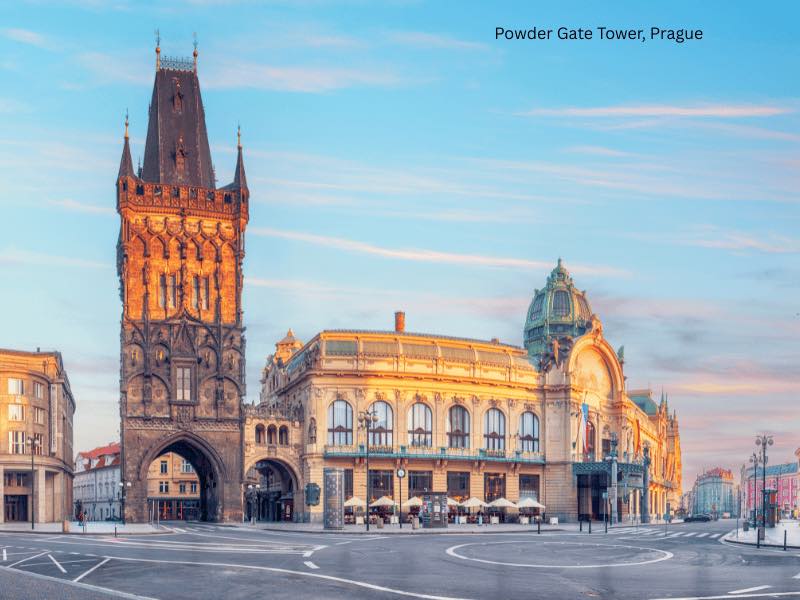
Completed in 1475, the Powder Gate Tower (Prašná brána), which formerly served as a gunpowder store during the 17th century, is the last remaining city gate of the original 13. Connected to the Municipal House, it separates the Old Town from the New Town. For 190 CZK (9 USD), visitors can climb the 186 narrow steps to a small gallery with sweeping views over Old Town.
7. Take in a concert
As you pass churches in the historic centre, keep an eye out for posters advertising concerts. This is how we stumbled across an evening concert at St Nicholas Church. For a modest fee, sitting in a beautiful church built in the 1730s and listening to an accomplished Czech organist and soprano was a fitting end to a remarkable day.
Or book a performance at one of many performing arts venues across the city, such as the Municipal House, Estates Theatre, Rudolfinum, or Spanish Synagogue. Consult sites such as ClassicTic, Prague City Tourism, Prague Classical Concerts, Prague Ticket Office, and Prague Experience for suggestions. Another option is to combine a performance with dinner (e.g., Mozart Dinner).
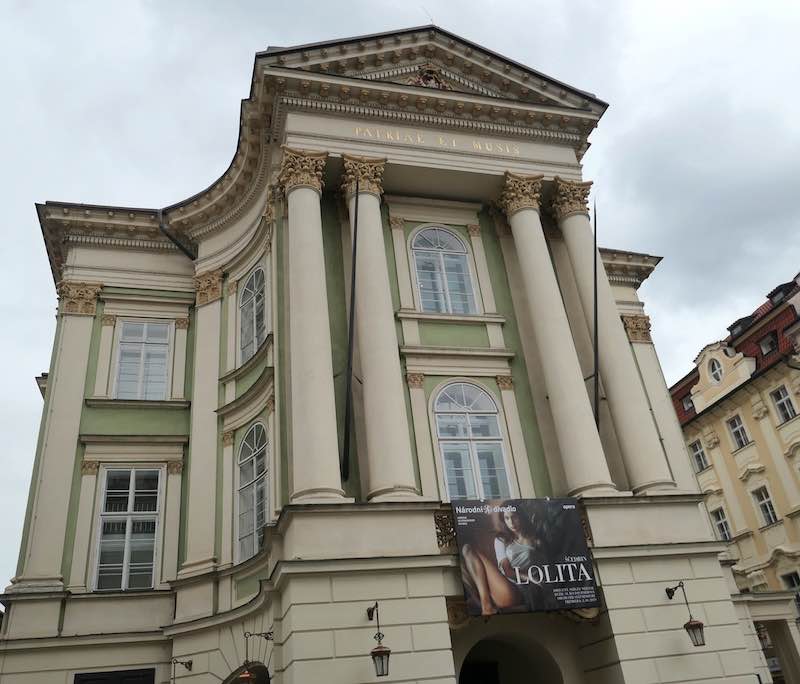 Estates Theatre, Prague
8. Check out the Il Commendatore Statue
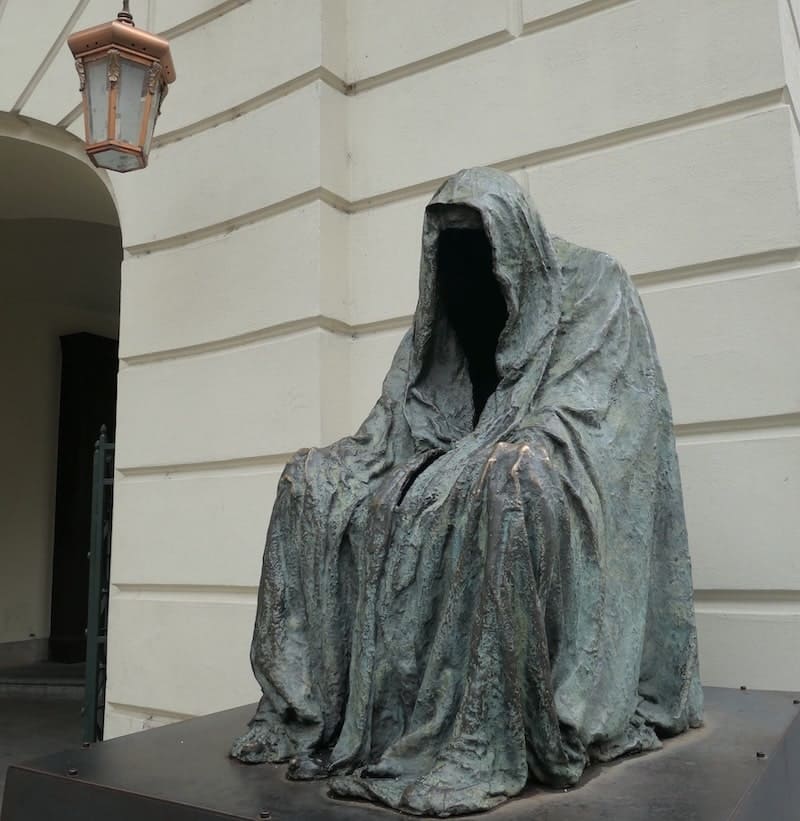
Also known as The Cloak of Conscience, the bronze sculpture Il Commendatore by Czech artist Anna Chromý depicts a large, hollow cloak without a visible figure inside. It’s outside the Estates Theatre in Prague, where Mozart’s opera Don Giovanni premiered in 1787. The sculpture was inspired by the opera’s character, the Commendatore, whose ghost appears at the end. The piece symbolizes absence, mystery, and conscience. Similar versions of the statue can be found in Salzburg, Monaco, and Vienna, as well as a marble version in Pietrasanta, Italy.
9. Sign up for a bike tour with Praha Bike
A bike tour is an enjoyable way to get to know a city. Praha Bike offers several tours, including the 2.5-hour Classic City Bike Tour, an easy 10-kilometre ride with no hills. Wireless receivers ensure everyone stays connected to the guide with commentary and safety instructions at stops and during the ride. It was the best city bike tour I’ve ever taken.

For self-guided options, Praha Bike rents a selection of bicycles, including tandem, mountain, children’s, and electric bikes. The company offers pre-planned routes with QR map codes accessible by phone.
Or, download a bike-sharing app such as Rekola or Nextbike and research cycling routes. Like most cities, the cycling infrastructure is undergoing gradual development with safe, scenic routes for cyclists.
10. Explore the Jewish Quarter
Prague has the best-preserved Jewish history in Europe. While Jews were rounded up by the thousands and sent to death camps during the Nazi occupation of Czechoslovakia, ironically, many of their buildings survived because of Hitler’s plan to preserve Prague’s Jewish Quarter as a memorial to an extinct people. Tragically, millions perished during the Holocaust, but ultimately, the Final Solution failed. By March 1945, with only 2.5% of the Jewish population surviving, this area became a point of inspiration for Jews around the world as a poignant testament to centuries of vibrant Jewish life, persecution, and resilience.
The quarter, also known as Josefov, was settled in the 13th century as a segregated Jewish Ghetto when Jews living in Prague were ordered to vacate their homes and settle in the designated area. Jews were banned from living anywhere else in the city and were joined by exiled Jews from other European countries.
Josefov is a five-minute walk from the Old Town Square, and Trams 17 and 18 stop nearby.
Significant sites include:
- The Pinkas Synagogue, built in 1535, is a moving memorial to the Jewish victims of the Holocaust, with the names of nearly 80,000 Czech and Moravian Jews inscribed on its walls.
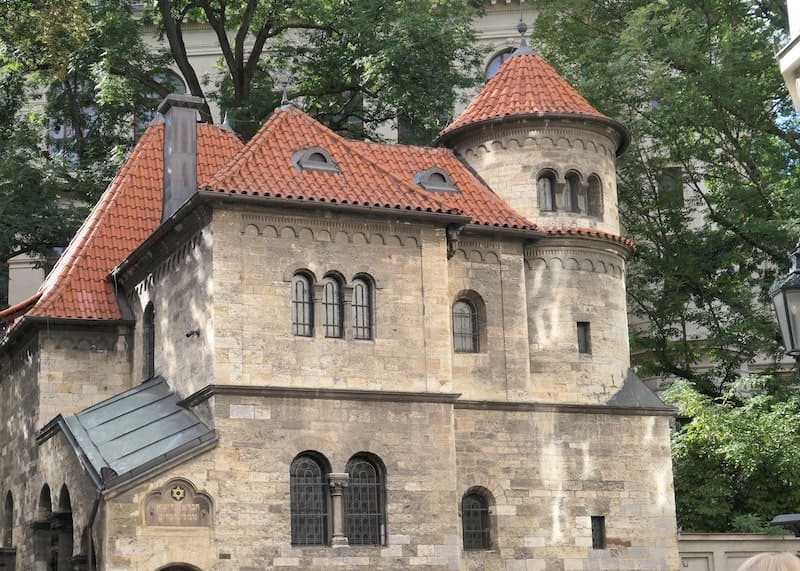
- Built around 1270, the Old-New Synagogue (Staronová Synagoga), is the heart of the small Jewish community in Prague. It is the oldest active synagogue in Europe.
- Operating from the 15th to 18th centuries, the Old Jewish Cemetery (Starý Židovský Hřbitov) is one of the oldest Jewish burial grounds in the world. With limited space in the quarter, graves were layered up to 12 deep, creating a dense landscape of over 12,000 visible, leaning tombstones.
- The Spanish Synagogue (Španělská Synagoga), with its spectacular interior, houses an exhibition of the modern history of Jews in the Czech lands. A small concert hall regularly hosts performances of classical music.
- Located at the entrance to the Old Jewish Cemetery, the Klausen Synagogue served a congregation established in the 1570s. In 1984, the former synagogue was permanently repurposed as a museum.
11. Stroll through Letná Park
Perched on a plateau overlooking the red-roofed city of Prague, the sprawling Letná Park (Letenské Sady) offers arresting views over the Vltava River and its bridges. It also houses the oldest functioning carousel in Europe, a very popular beer garden, and meandering walking and jogging paths.
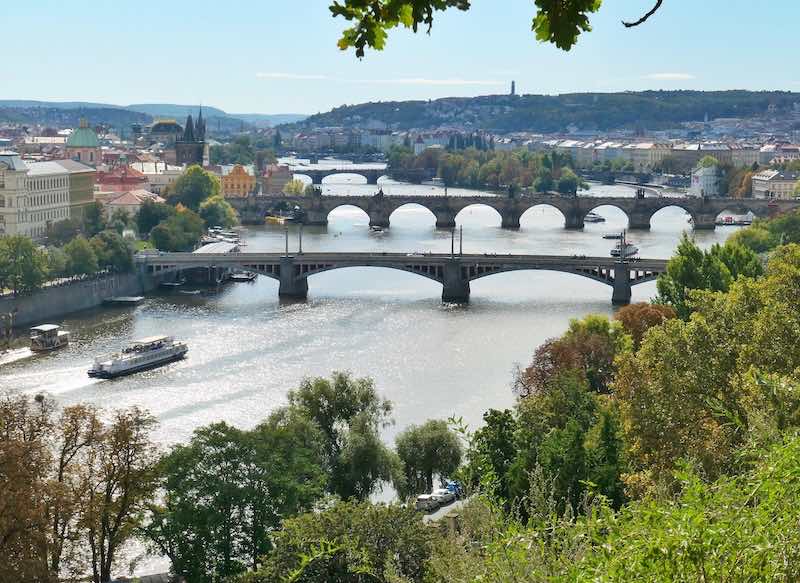
For a short period during the Communist era, the world’s largest statue of Soviet dictator Josef Stalin stood in Letná Park. It took five years to build, with tragic consequences for the sculptor, Otakar Švec and his wife, who both committed suicide before the statue was unveiled in 1955. The process of de-Stalinization began shortly after by Stalin’s successor, Nikita Khrushchev, yet the statue survived another seven years. In 1962, it took more than 800 kilograms of explosives to destroy the statue. Today, the massive pedestal scarred by graffiti is all that remains of the granite statue.
12. Wander beside the Vltava River
The Vltava River frequently overflows its banks; several weirs and locks have been built to mitigate water flow and curb flooding. Along the riverbank, long lines of tracks receive mobile metal barriers to protect the historic centre during severe flooding.
The European floods of 2002 caused significant and costly damage to Prague totalling one billion euros. The flood height is marked by the intersection of grey and orange paint on this building near the Charles Bridge.

13. Take a boat tour on the Vltava River
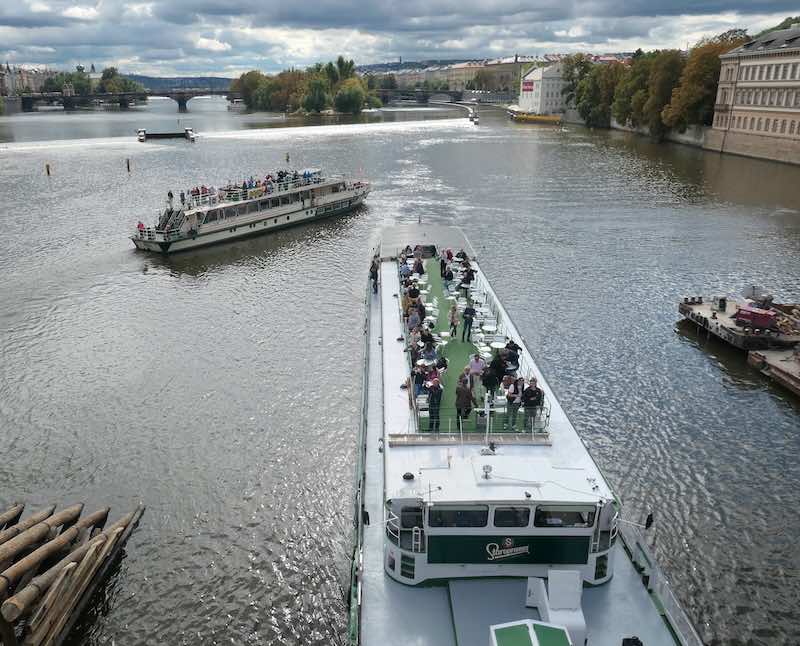
Getting to know a city and its many historical buildings, bridges, and monuments from its river offers a different perspective from exploring it on land. Choose between sightseeing, lunch, dinner, sunset, jazz, themed, or eco-cruises of varying durations, bookable on various platforms. Cruises operate year-round, and many of the larger boats offer heated glass-top seating.
14. Relax on Kampa Island
Located beside the Vltava River and separated from Malá Strana by the Čertovka Canal, Kampa Island is a peaceful green space for enjoying the quieter side of Prague. Kampa Park is a scenic public park with an excellent view of Charles Bridge and the site of the Kampa Museum of Modern Art. David Černý’s ‘Crawling Babies’ dominate the outdoor space beside the museum.
15. Kayak the Čertovka Canal
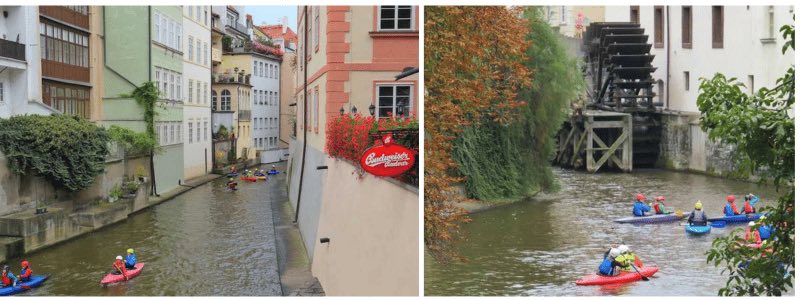
The Čertovka Canal, also known as the ‘Devil’s Canal’ or ‘Devil’s Stream,’ is often referred to as ‘Little Prague Venice’ due to the historic houses built along its narrow banks. Approximately 740 metres long, the artificial channel was dug in the 12th century to power a series of water mills. One of the most famous sights along the canal is the Grand Priory Mill (Velkopřevorský Mlýn), with the large, spinning blades on the attached wooden water wheel. Pedestrians can enjoy views of the canal from bridges, but a trip on the water reveals its real charm. For a guided option, Prague Venice offers a tour aboard a 19th-century boat with the cruise including parts of the Vltava River.
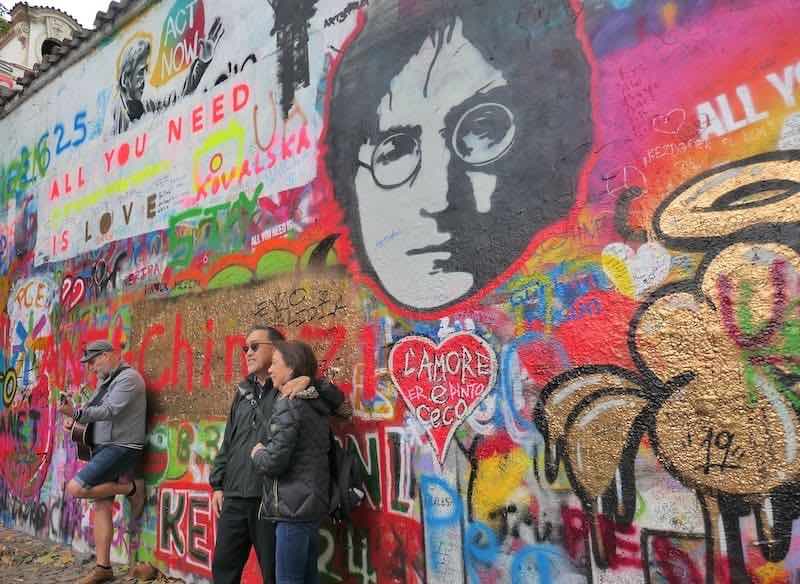
16. Check out the Lennon Wall
In Grand Priory Square on Kampa Island, near the Charles Bridge, is the Lennon Wall, with its rich history as a symbol of freedom, peace, and rebellion. Since the 1980s, it has been a canvas for John Lennon-inspired graffiti and snippets of Beatles lyrics. After Lennon’s 1980 murder, young Czechs turned the wall into a protest against the repressive communist regime that would periodically paint it over, leading to a cycle of painting and repainting. Artwork covers every available surface, regularly updated with fresh designs, so each new visit is unlike previous ones.
17. Stroll across the Charles Bridge
Walking across the 14th-century Charles Bridge (Karlův Most) is one of Prague’s most popular experiences. The bridge is an impressive stone structure, 621 metres long and 10 metres wide, lined with 30 beautiful statues of saints. They’re replicas; the originals are in the National Museum. Since 1357, Charles Bridge has withstood war, revolution, and floods. Until 1841, it was the only bridge crossing the Vltava River. Today, it’s open only to pedestrians.
It’s usually crowded with tourists, and a constant battery of street musicians and vendors sell jewellery, souvenirs, paintings, and caricatures. It’s quiet and peaceful in the early morning, and walking across the bridge at sunrise is markedly different from any other time of day.
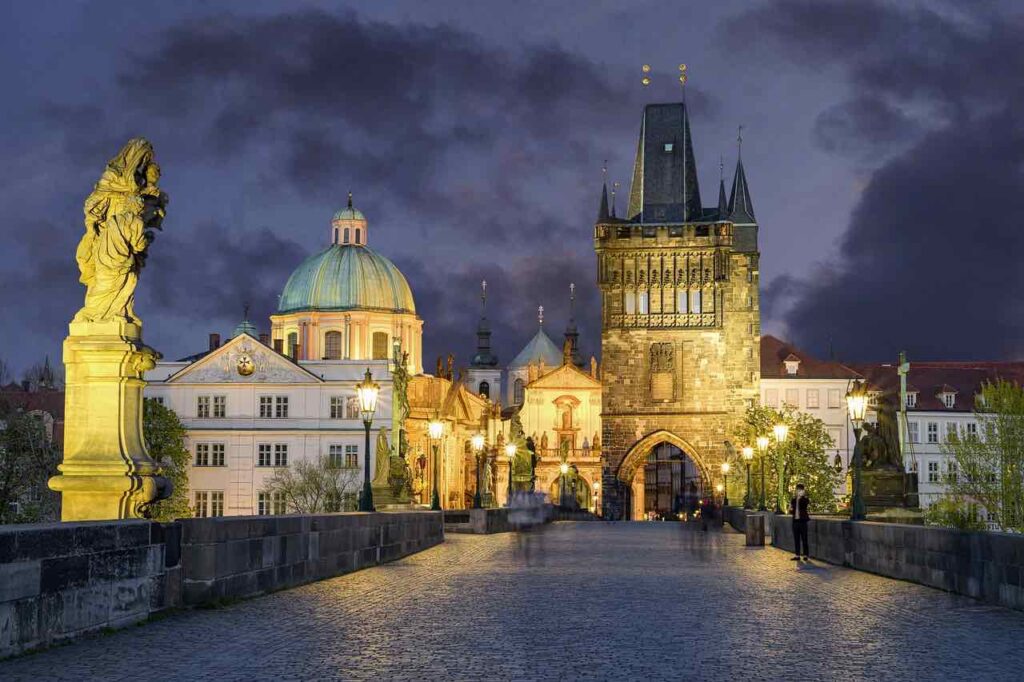 Photo credit: František Zelinka, Pixabay
18. Pause by the statue of St John on the Charles Bridge
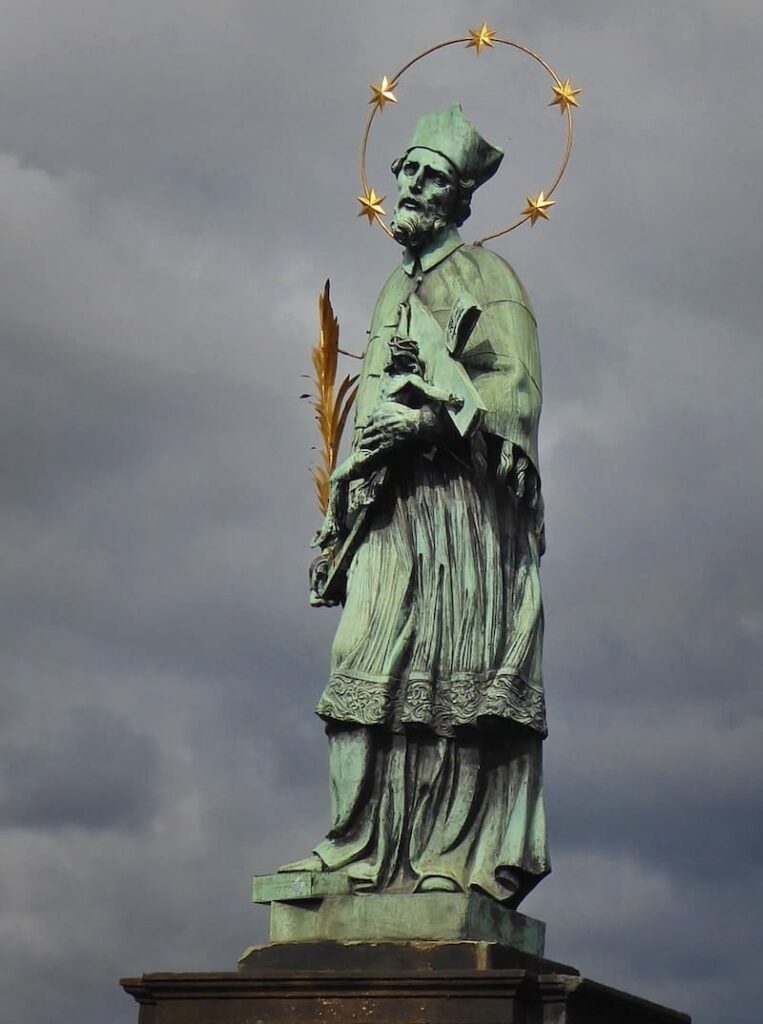
The most notable statue on Charles Bridge is that of St John of Nepomuk, a priest under King Wenceslas IV. St John would take the queen’s confessions, and when the king asked what she had confessed, he refused to share any details. As a result, Wenceslas ordered his execution in 1393, then had his body tossed into the Vltava from the bridge. His body was eventually retrieved, and it rests today in the St Vitus Cathedral in the Prague Castle.
The five stars in the halo are a unique feature, said to have appeared in the sky when St John drowned. On the pedestal below is a bronze plaque depicting his execution. The patina on the railing beside it is shiny, where millions of hands have rubbed it over the years for good luck.
19. Admire the work of David Černý
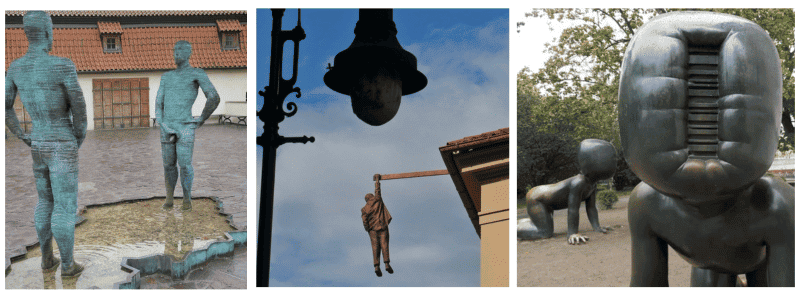
David Černý is a renowned and often controversial Czech sculptor known for provocative, politically charged public art. Born in 1967 in Prague, he first gained international attention in 1991 when he painted a Soviet tank pink. The bold act of defiance was a political statement against communist symbolism, leading to his arrest and turning the ‘Pink Tank’ into an icon of post-Velvet Revolution freedom and protest in Prague.
- ‘Man Hanging Out’ at the intersection of Husova and Skorepka depicts Sigmund Freud suspended by one hand, symbolising intellectual uncertainty and angst at the turn of the millennium, as thinkers questioned their role as humanity entered the new century. Freud was born in Freiburg, which is now part of the Czech Republic.
- Another of David Černý’s sculptures is ‘Pissing Statues’ outside the Franz Kafka Museum on Cihelná Street. The mechanical-fountain sculpture depicts two men with swivelling hips and moving genitalia urinating in a pond in the shape of a map of the Czech Republic. It’s a commentary on the self-deprecating Czechs, who Černý contends have gritted their teeth through centuries of invasion and occupation, barely resisting and rarely winning.
- David Černý’s ‘Miminka’ (Crawling Babies), with a barcode-like mechanical pattern stamped on their faces, signifies how technology reduces people to a collection of digital data. Miminka occupy the riverside space next to Kampa Museum of Modern Art, housed in a former mill.
To find other David Černý’s sculptures, see Tracking the Works of David Černý.
20. Squeeze through Prague’s narrowest alley
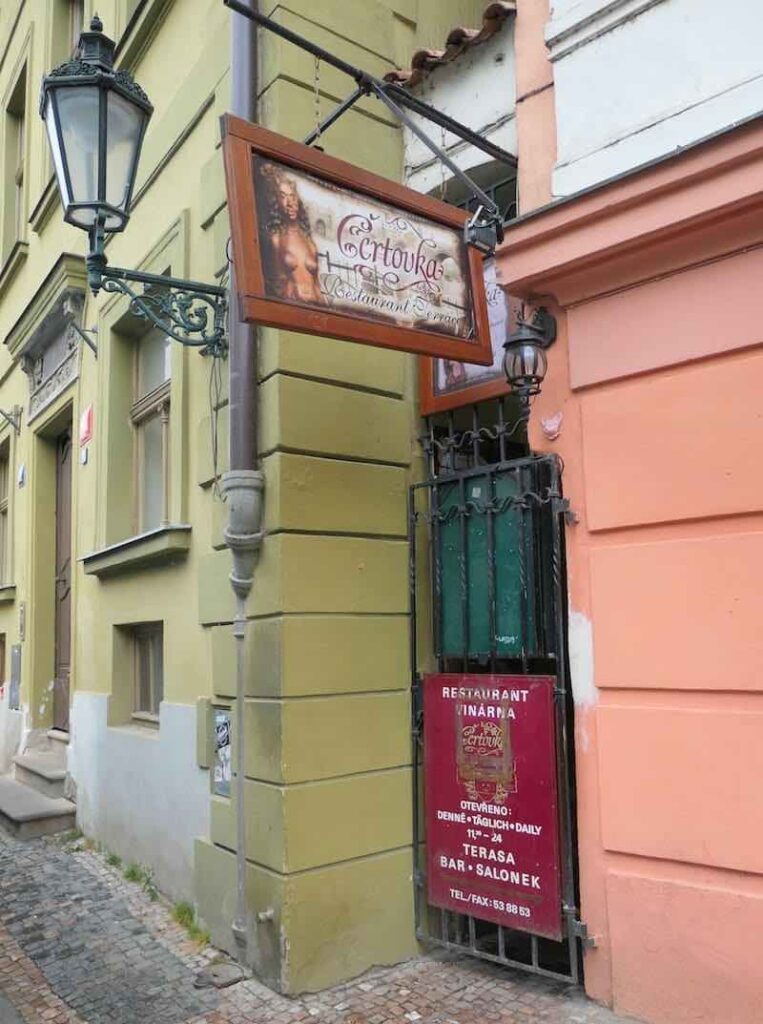
Vinárna Čertovka (also called Čertovka) is famous for being so narrow (about 50 centimetres or 20 inches wide) that it requires traffic lights at both ends to manage one-way pedestrian traffic. Originally a fire escape route, it now serves as a quirky tourist attraction, connecting U Lužického semináře Street with the courtyard of the Čertovka restaurant and the Čertovka Canal area.
21. Pause by the Velvet Revolution Memorial
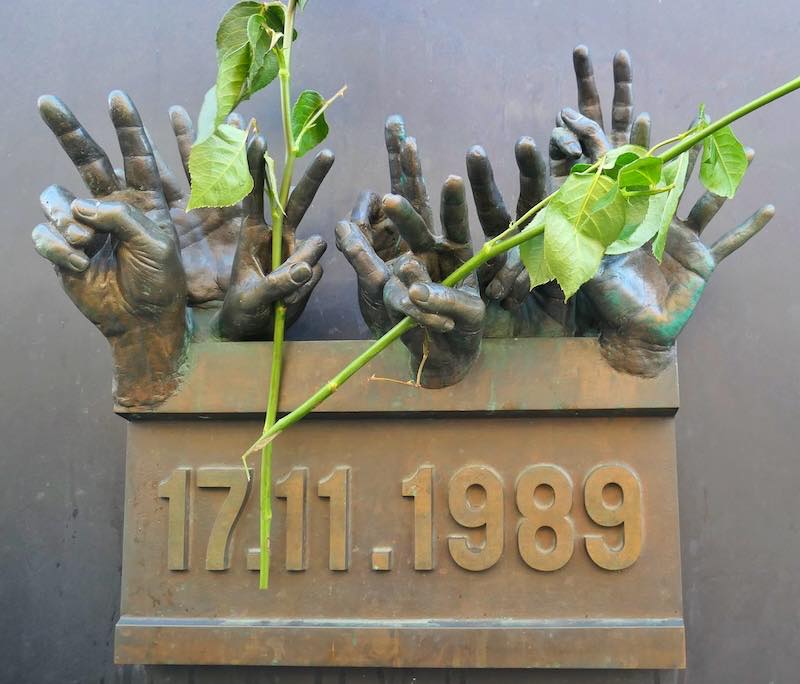
The memorial on Národní třída (National Street) marks the spot where student protests were brutally suppressed on November 17, 1989, sparking the Velvet Revolution. The bloodless revolution led to a return to democracy after 50 years of Nazi occupation and communist rule. The memorial serves as a focal point for remembrance, with candles and flowers often left to honour the peaceful transition.
22. Pay tribute to the Heroes of the Heydrich Terror
The Cathedral Church of Saints Cyril and Methodius is known as the Parachutists Church. During the period of Nazi occupation beginning in 1939, resistance fighters took refuge in the church following Operation Anthropoid, the 1942 assassination of Reinhard Heydrich, the third-highest-ranking Nazi and a key architect of the Final Solution.
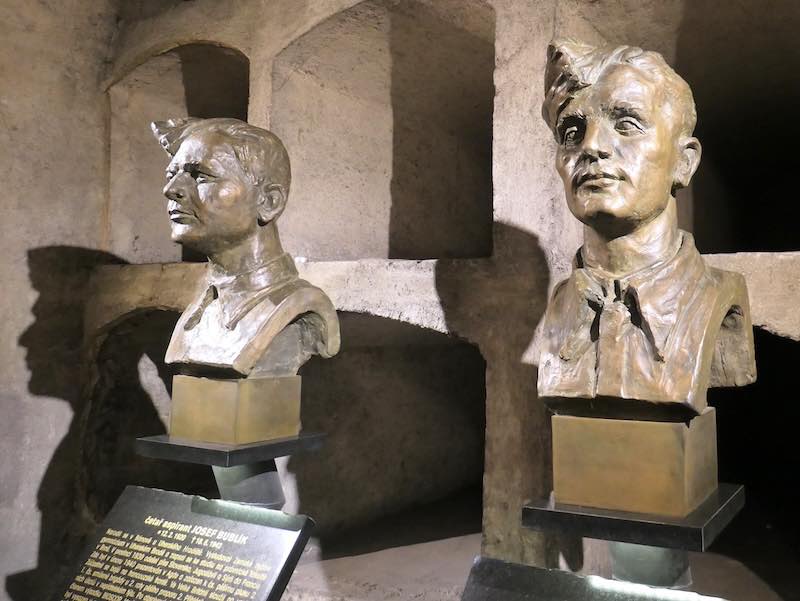
The church’s basement houses the National Monument to the Heroes of the Heydrich Terror, who carried out one of the most extraordinary acts of wartime resistance in occupied Europe. There are tributes to the seven paratroopers involved in the assassination and the church leaders who provided sanctuary. Information panels describe the brutal Nazi occupation, the Resistance, and the periods before and after the assassination. Bronze busts of the seven paratroopers stand in the crypt near the deep stone shafts cut into the walls for coffins. Hitler’s orders were to capture them alive but with the church surrounded by 700 troops, the paratroopers took their own lives by cyanide or gunshot.
23. Visit the memorials to Jan Palach and Jan Zajíc
Wenceslas Square is etched in history. Here, in 1918, the first Czechoslovak Republic declared independence. In 1945, it became a battleground during the Prague Uprising, where Czechs fought German troops. In 1969, Jan Palach, a university student, burned himself to death outside the National Museum to protest Soviet occupation following the 1968 invasion by the Warsaw Pact armies of 500,000 troops and 6,300 tanks, ending the Prague Spring reforms introduced by Alexander Dubček. His compatriot Jan Zajíc, followed Palach’s example of self-immolation a short time later.
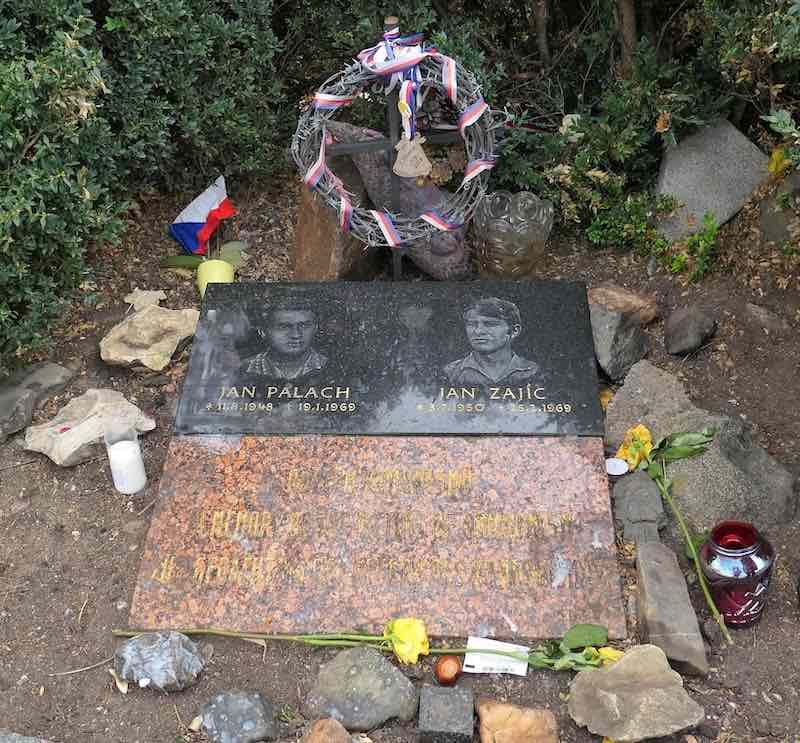
In 1989, hundreds of thousands gathered in Wenceslas Square during the Velvet Revolution to demand an end to the communist era. Pausing by the Palach-Zajíc memorial invites solemn reflection on the efforts and sacrifices of ordinary Czechs to escape repressive regimes.
24. Enjoy drinks with a view at the Dancing House
A corner lot on the bank of the Vltava River stood vacant for decades after a US air raid in 1945. It’s not clear if the bombing was intentional, an accident due to bad weather, or the fact that Prague and Dresden looked similar from the air. Accident or not, the bomb made space for the Dancing House (Tančící Dům), built several decades later and completed in 1996. Also known as ‘Fred and Ginger’ (Fred Astaire and Ginger Rogers), the Nationale-Nederlanden Building appears to twist and dance beside the Vltava River, rising from the ashes of destruction during a repressive period of Prague’s history.
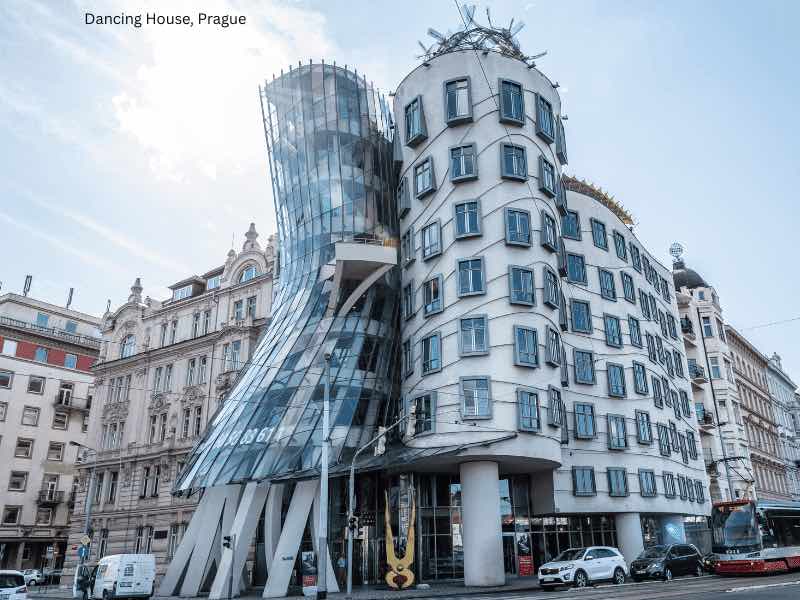
The rooftop bar (Glass Bar) has an outdoor terrace with superb views.
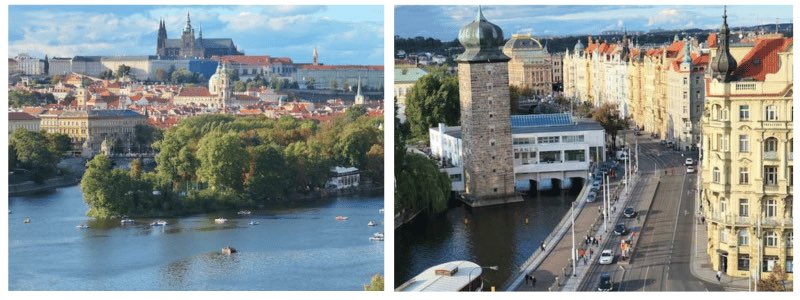
25. Take the ‘Prague Communism and Nuclear Bunker Tour’
During the Cold War era following World War II, a network of bunkers was built under the streets and parks of Prague. Most built in the 1950s have been neglected and are no longer safe to enter. The one used by the tour company is under a park in the Žižkov district. Taking a tram to the bunker revealed an unexpected treat: seeing David Černý’s ten giant baby sculptures crawling up the sides of the Žižkov Television Tower.
We descended 16 metres, about four floors, to a labyrinth of narrow passageways and small rooms, to explore roughly 20% of the bunker. For a detailed description of the tour, see: A fascinating nuclear bunker tour in Prague.
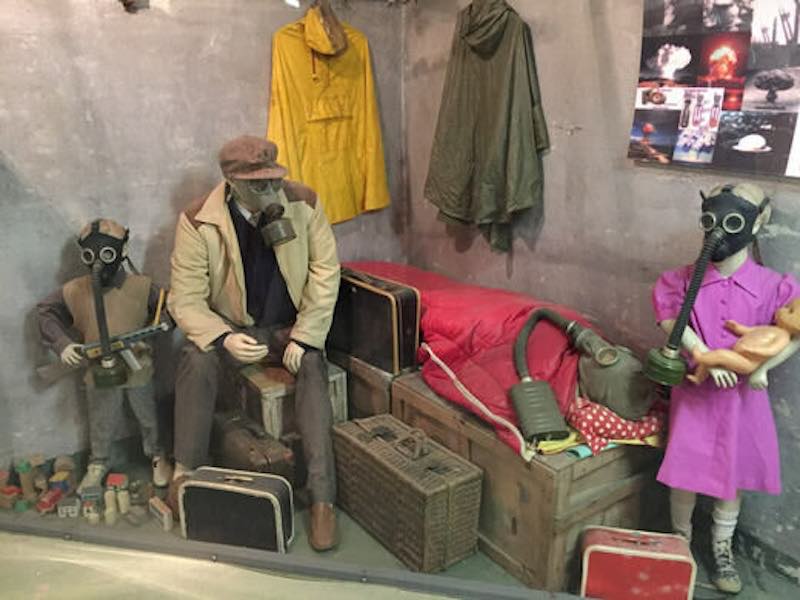
26. Ride the Petřín funicular
In service since 1891, the Petřín funicular (Lanová dráha Petřín) climbs the slope of Petřín Hill, with its stunning panoramic views of Prague and, on a clear day, nearly all of Bohemia.
The funicular from Újezd to Petřín Hill is part of Prague’s public transport system and is a popular way to reach the Petřín Lookout Tower. Trams 9, 12, 15, 20, and 22 all stop at Újezd.
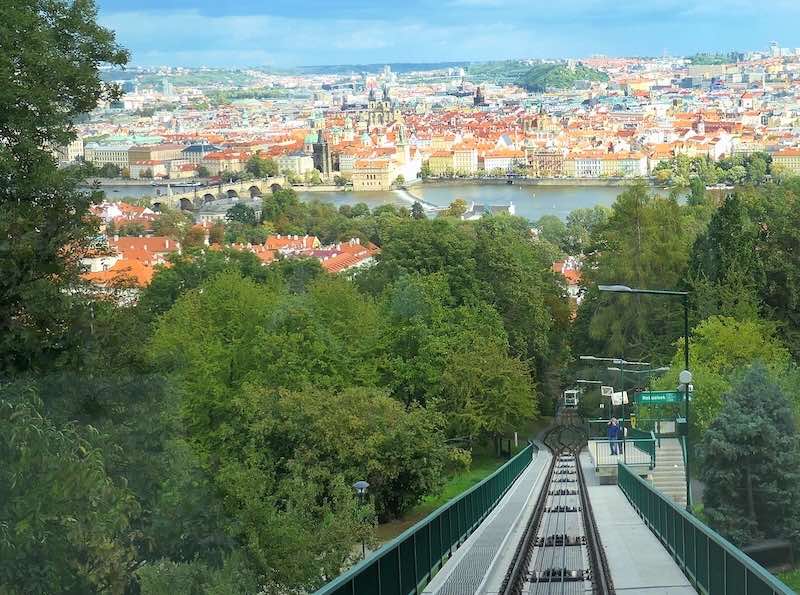
27. Enjoy the views from Petřín Lookout Tower
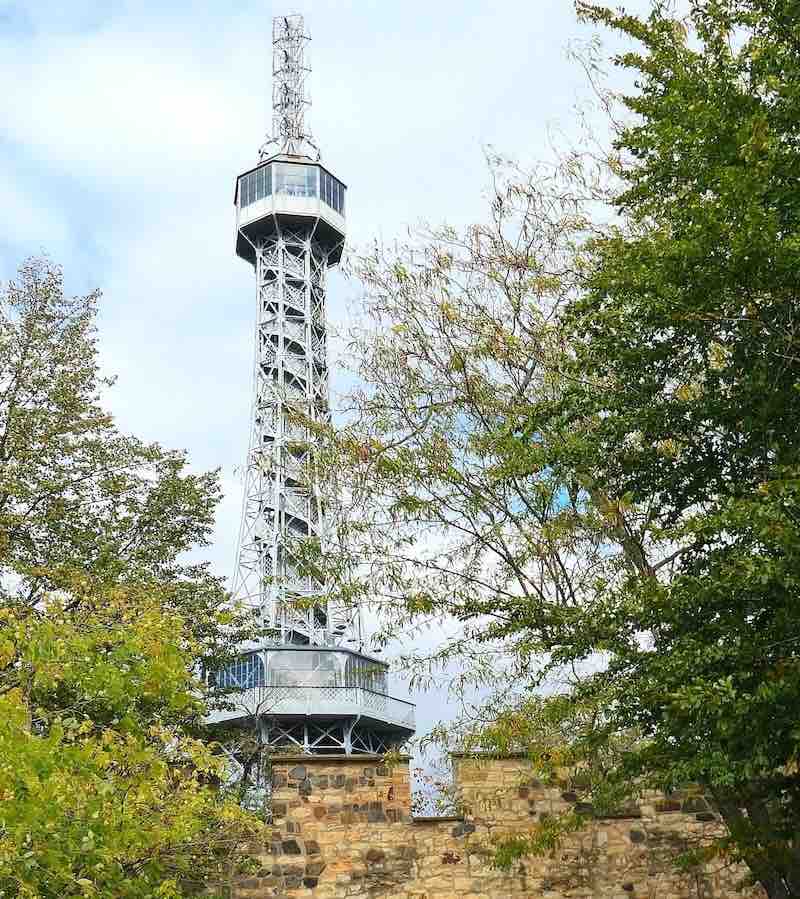
Built in 1891, the Petřín Lookout Tower (Petřínská rozhledna) was inspired by the design of the Eiffel Tower in Paris. It sits on Petřín Hill, one of the greenest spaces in Prague, accessible via the Petřín funicular or take the Monastery Garden Path for a leisurely ten-minute stroll from the Strahov Monastery.
The steel-framework tower is 63.5 meters (208 feet) tall with an observation deck offering unrivalled 360-degree views of Prague’s spires, domes, and terracotta rooftops. The admission fee is 220 CZK (10.60 USD) or 150 CZK (7.20 USD) for students and seniors. Climb the 299 steps to reach the viewing platform, or take the elevator for an additional cost of 60 CZK (2.90 USD).
28. Wander around the Prague Castle
One of the busiest trams for tourists is Tram 22 which climbs up to Prague Castle and the Strahov Monastery.
Prague Castle (Pražký hrad) is the largest castle complex in the world.
The site attracts many visitors for good reason. First built in 870, the castle has been the home of several Roman Emperors, Bohemian Kings, and Czechoslovak and Czech presidents. With such a long history, almost every architectural period is represented. The complex is immense, covering almost 70 thousand square metres. Given its size, multiple ticket options, and so much to see and do, planning a visit can feel overwhelming. Some prior research will help make the most of available time. This handy resource from Earth Trekkers might be helpful.
Entry to the castle complex is free. After passing through security, visitors are free to roam the grounds; however, entry to most buildings requires a ticket. Many options exist, such as skip-the-line tickets with an audioguide or small-group tours with an experienced guide.
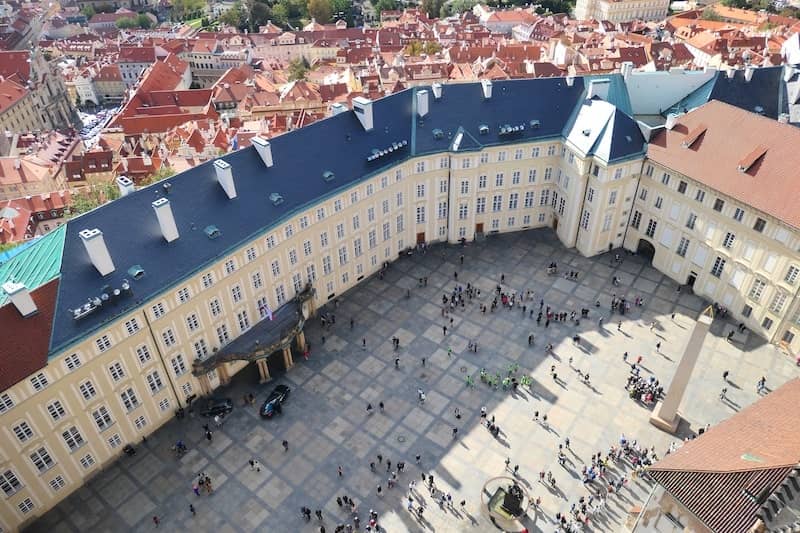
The main circuit ticket gains entrance to St. Vitus Cathedral, St. George’s Basilica, the Old Royal Palace, and the Golden Lane, a narrow cobbled street lined with small, colourful houses of castle guards, goldsmiths, and servants. It costs 450 CZK (21.65 USD) or 250 CZK (12 USD) for students and seniors.
29. Witness the Changing of the Guard at Prague Castle
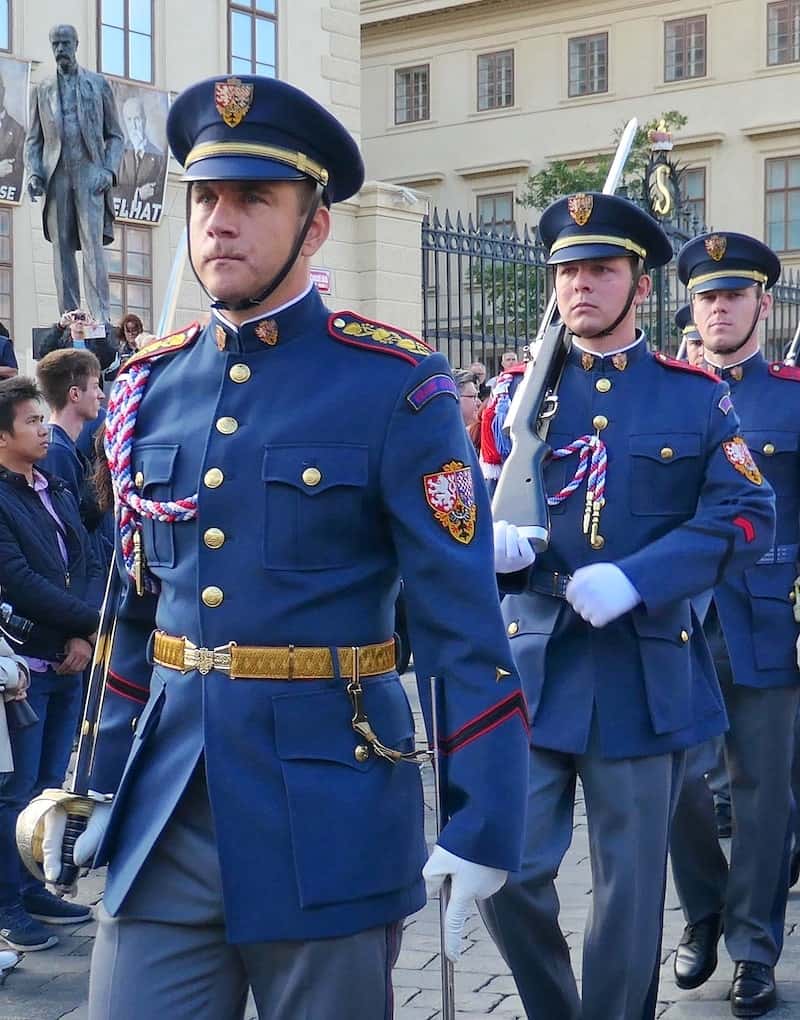
The Changing of the Guard at the castle is a daily ceremonial event in the First Courtyard at noon featuring the Czech Armed Forces. The formal event involves trumpets and drums, a banner exchange, and precision marching by the Castle Guard.
Hourly changes are on the hour from 07:00 to 18:00 at the Titan’s Gate and the Powder Bridge Gate. Neither of these events requires a ticket.
30. Step inside St Vitus Cathedral
If you have time to visit just one building at Prague Castle, choose St Vitus Cathedral, a masterpiece of Gothic architecture. The highlights include the massive stained glass windows, the Chapel of St. Wenceslas, and the tombs of Czech kings and saints.
Dominating the skyline, the Great South Tower stands almost 100 metres above the castle. Tackling the 287 steps to the viewing gallery at 52 metres is worth the climb and 200 CZK (9.60 USD). Pause frequently to admire the massive bells. One of them is so big that six bell-ringers are needed to operate it – four to swing the bell into motion and two to manipulate the clapper.
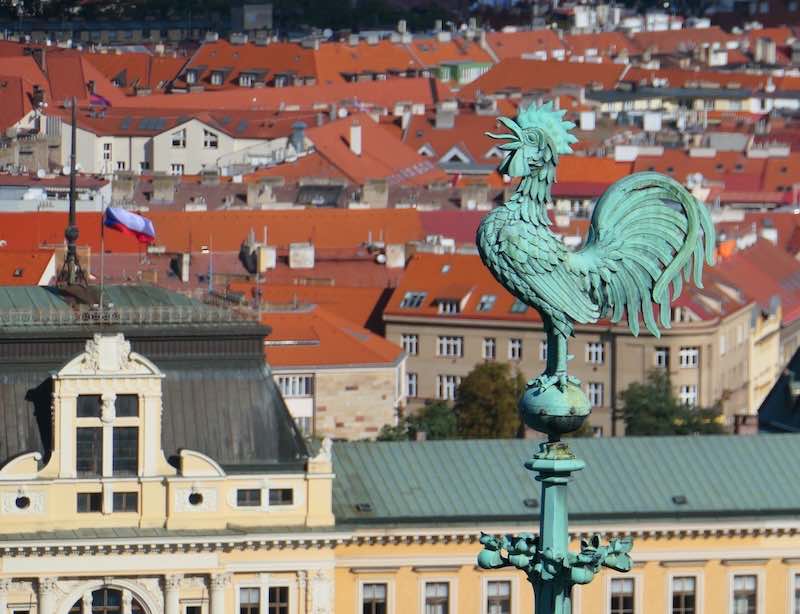
From the gallery, enjoy a picturesque view of Prague and its many bridges, with the cathedral’s rooster weathervanes in the foreground. For more information, see Best view of Prague from St Vitus Cathedral, Prague Castle.
31. Don’t miss Strahov Monastery
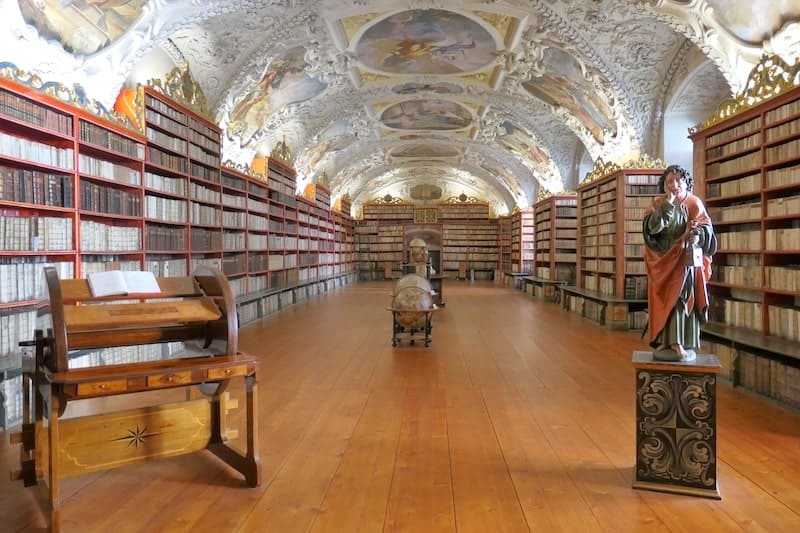
Just a few minutes’ walk from Prague Castle, Strahov Monastery is famous for its incredible library of old books and illuminated manuscripts. The complex also houses a basilica, an art museum, a brewery, the Museum of Miniatures, and the Galerie MIRO, with modern art exhibits.
The magnificent Strahov Library is renowned for its beautiful Baroque architecture, centuries-old globes, and an extensive collection of over 200,000 volumes, including ancient manuscripts and thousands of first prints. The library is divided into two main halls: the Theological Hall and the Philosophical Hall, both adorned with intricate frescoes and woodwork.
32. Enjoy a brew at the Strahov Monastery
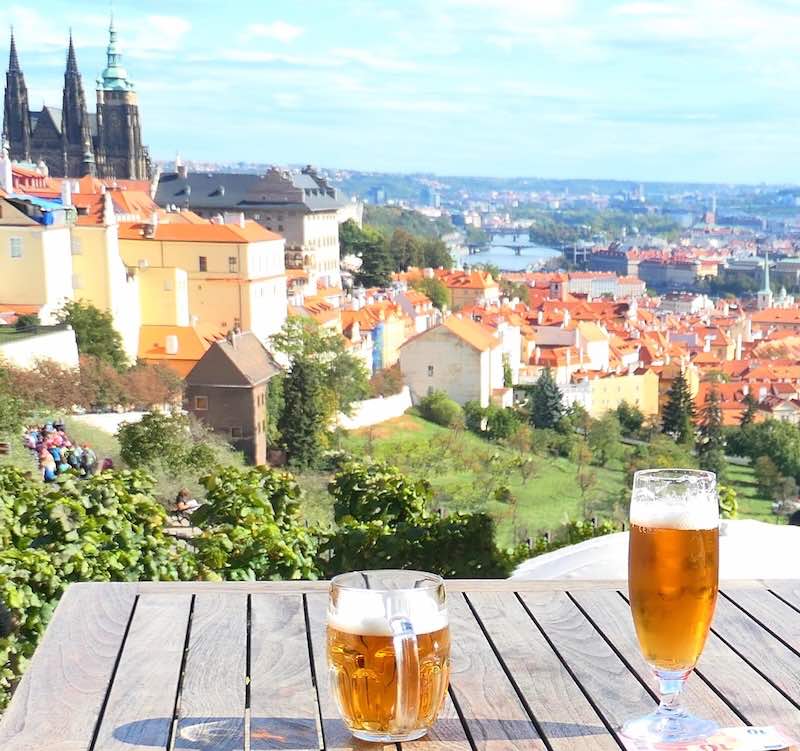
The Czech Republic consistently ranks as the world’s top beer consumer per capita, cementing beer’s cultural and historical importance since it was first brewed in monasteries over a thousand years ago.
The brewery at the Strahov Monastery has roots that stretch back to the monastery’s 12th-century founding, with written records of brewing dating back to 1400. After supplying monks and visitors with beer for centuries, the brewery ceased production in 1902, only to be revived in 2000.
Enjoy a beer brewed on monastery grounds while soaking up the superb views overlooking St. Wenceslas’ Vineyard. Legend has it that Prince Wenceslas tended these vines back in the 10th century. The terrace also boasts a restaurant serving hearty Czech dishes.
33. Take a day trip to Kutná Hora
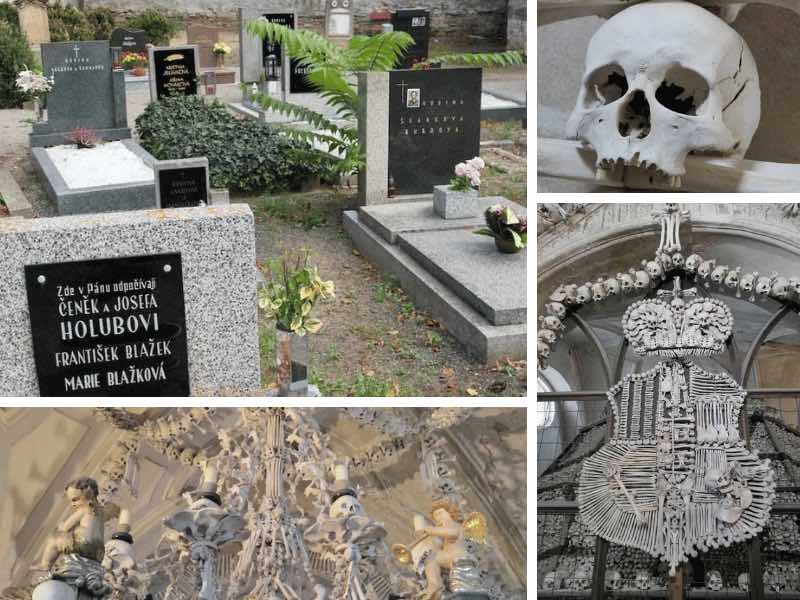
In Kutná Hora, about an hour’s journey from Central Prague by train, is the Sedlec Ossuary, otherwise known as the ‘bone church.’ The small chapel is famous for its interior, decorated with the skeletal remains of an estimated 40,000 to 70,000 people, arranged artistically by the woodcarver František Rint in the late 19th century. Elaborate decorations include a chandelier, garlands of skulls, and the coat of arms of the Schwarzenberg family that bought the ossuary property. The chapel is considered a sacred place, with displays intended to reflect the transience of life and the hope of an afterlife.
A UNESCO World Heritage Site, Kutná Hora is best enjoyed as a day trip. There’s so much more to see, such as St Barbara’s Cathedral, the Czech Museum of Silver, a tour of an underground medieval silver mine, or a stroll around the beautiful, crowd-free historic centre.
Take a train from the Prague Main Station and then the local shuttle train between Kutná Hora město and Kutná Hora hlavní nádraží if you’re short on time.
Conclusion
Prague is a safe, must-visit city that deserves to be included on any European adventure. Its vibrant arts and culture scene, affordability, walkability, delicious cuisine, excellent public transportation network, and stable political and economic systems make it an ideal destination. For budget-conscious travellers, it’s less crowded and more affordable than Western European countries and most capitals, such as London, Paris, and Rome.
If you found this post helpful, please share it on your favourite social media channel(s) by clicking on the respective button(s). Would you care to comment on anything included on this list of tips and suggestions for travel to Prague? Do you have any other suggestions? Please share your thoughts in the comments. Thank you.
Care it pin it for later?