
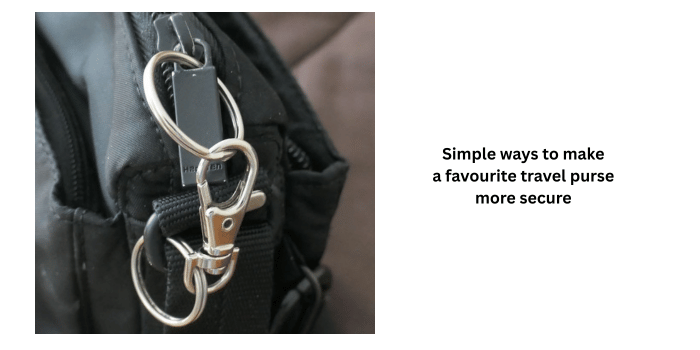
Does your favourite crossbody purse come up short on security features? If so, these simple ways to make a favourite travel purse more secure might offer just the inspiration you need to improve its effectiveness against carelessness or theft.
My journey to find the perfect travel purse
Undoubtedly, many others can relate to what can be a difficult quest to find a favourite travel purse. Once it’s found, is it safe from pickpockets or loss of critical items due to carelessness? My journey is filled with many missteps and poor purchasing decisions. However, several useful experiences have influenced the kinds of features I now look for in a travel purse.
These include:
- Dealing with ill-conceived travel products for essential travel documents while negotiating airport security and a check-in desk has convinced me that my travel purse needs to double as a document holder.
- Reports of theft at security checkpoints show that a purse must be small enough to fit inside a personal item or main carry-on bag, hidden from the prying eyes and loose fingers of opportunistic thieves.
- While travelling by public transportation, exploring a destination, navigating crowded places in touristy areas, shopping, or dining out, a purse needs to be comfortable enough to wear without hanging it on the back of a chair, resting on the ground, or stowing in a seatback pocket. These kinds of scenarios can result in theft or being left behind.
- While travelling, it needs to be small enough to protect with one hand or wear under a jacket, yet large and light enough to carry daily essentials.
- It needs to be packable, capable of nesting inside another bag when circumstances warrant.
- Experimenting with Pacsafe, Baggalini, and Travelon purchases has resulted in products that are either too small to carry essentials or too large and heavy to wear comfortably for extended periods. Besides, I often wonder if these anti-theft bags signal ‘tourist’ to thieves who prey on those they think have something of value to steal.
Features I appreciate in a travel purse
- Zippered external pockets, at least one in front and one in back (that sits against the body, away from the prying hands of pickpockets).
- A deep, main compartment with internal dimensions large enough to store important items, including a tablet (in my case, an iPad mini), especially on transit days.
- Additional pockets in the main compartment for a phone and a slim wallet.
- A separate zippered pocket to accommodate daily essentials such as lip balm, hand sanitiser, soap leaves, travel pack of bamboo pocket tissues, sunblock stick, face mask, and a pocket shopping bag. I prefer the internal organisation of a separate pocket, as opposed to one cavernous expanse where small items roam freely and are difficult to locate by sight or touch.
- A wide, adjustable strap for comfortable wear as a shoulder or crossbody bag for hands-free use.
- Available in a neutral colour that pairs with any outfit, it has no luxury or obtrusive branding, and is stylish and versatile enough for day and evening wear.
Modifying the Hedgren Eye
For a recent trip to Pakistan, Sri Lanka, and Thailand, I carried a Hedgren Inner City Eye Crossbody Shoulder Bag. At 22.1 x 8.89 x 19.05 centimetres (8.7 x 3.5 x 7.5 inches) and weighing 226.8 grams (8 ounces), it met my requirements for a small, lightweight purse. It boasted many of the features listed above, including three zippered external pockets and sufficient internal organization to meet my needs. Its volume is 3.5 litres.
Improving the security of a travel purse has several advantages.
- Deterring pickpockets and phone snatchers is a major objective. The goal isn’t to make a bag impenetrable, but to make it much harder to access than the open bags or bulging pockets of other people.
- Another is securing contents such as a phone or wallet against neglect or forgetfulness. I prefer to have my phone tethered to my purse when out and about, so there’s less chance it will sustain damage if dropped or exposed to the elements.
- Having stuff secure and in a consistent place elevates peace of mind and reduces those first heart-stopping moments associated with realising a phone, wallet, or passport isn’t where it should be.
Ways to make a favourite travel purse more secure
1. Collect supplies
Most supplies can be found at a hardware store, craft or hobby store, outdoor store, or online retailers. Or cruise dollar store aisles with a creative eye for possibilities. Check out the online marketplace, Etsy. Undoubtedly, there will be items around the house, such as a needle and thread, sewing tape, a split ring from an old set of keys, a clip from a lanyard name tag, a safety pin, or a carabiner gathering dust in a drawer.
Here are some ideas:
- Metal or plastic O-rings and D-rings are available in a variety of sizes. Tether straps for attaching an object to an O-ring or D-ring require a metal or plastic clip at each end. Metal lobster claw clasps and swivel clips are more durable than plastic clips.
- A variety of materials are used to create tether straps, including braided aluminum, nylon webbing, leather, or plastic. Each strap typically has a clasp, clip, carabiner, or split ring at both ends. Unlike fixed-length tethers or lanyards, a retractable design allows for a tethered item to be extended to the length needed for a specific task.
- Tether tabs come in different sizes and shapes, as well as non-adhesive and adhesive varieties. The adhesive type can be applied to the outside of an object, or the adhesive or non-adhesive variety can be placed inside a case, allowing a lanyard or tethering strap to connect through the charging port.
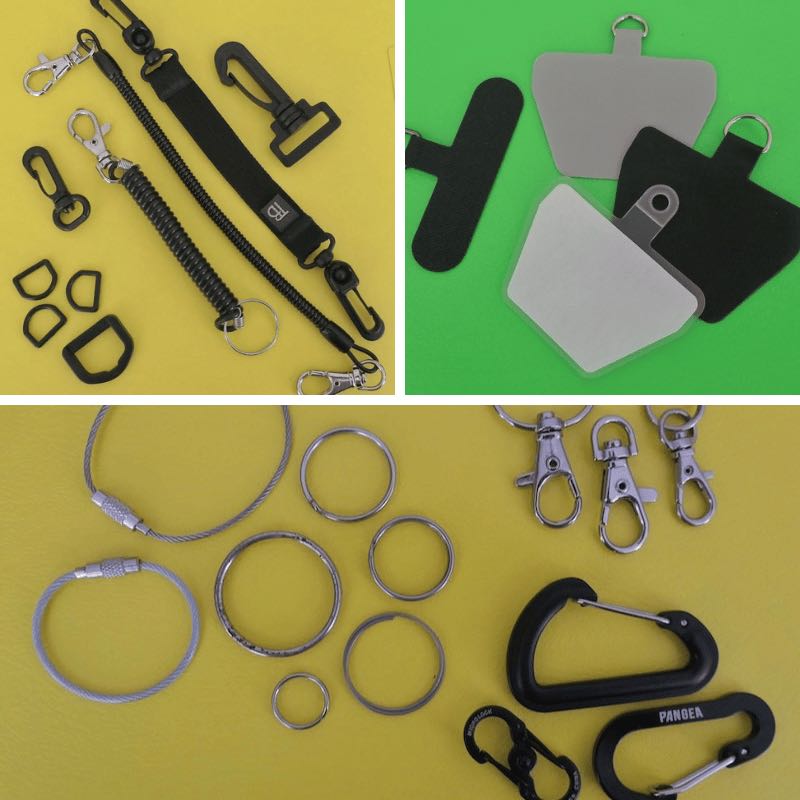
Selecting what works best depends on the purse’s design, its hardware, and possible attachment points.
2. Secure one or more zippers to an external attachment point
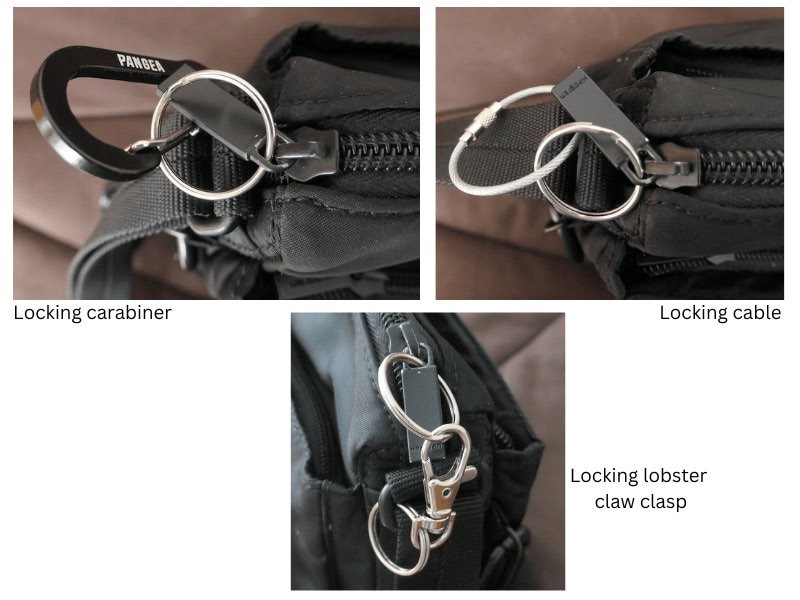
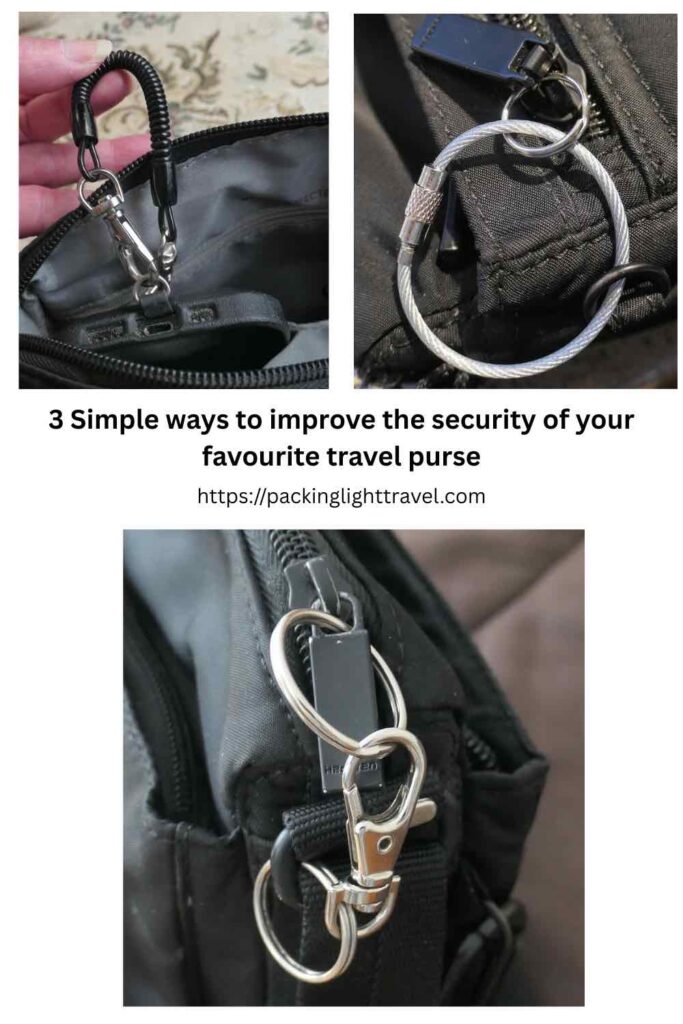
Where possible, make zippers lockable. Using the Hedgren Eye as an example, a hole in the zipper pull of the main compartment could accommodate a split ring, which could then be locked to the hardware of the adjustable strap.
Working with limited space (in the zipper pull and the strap hardware) and the supplies at my disposal, I found three options:
- An S-binerclip originally attached to a bamboo travel towel from Pangea fit perfectly in the space on the strap hardware, but it was finicky to open.
- A cable tie consumed the least space, but of the three options, it was the most difficult and time-consuming to unlock.
- A lobster-claw clasp required a split ring to attach it to the strap hardware, thereby increasing the visibility of the zipper lock. This is my preferred setup in pickpocket-prone destinations. Opportunistic thieves rely on stealth and speed, so I would hope that a pickpocket would conclude that such a minor obstacle isn’t worth the trouble and would move on to an easier target.
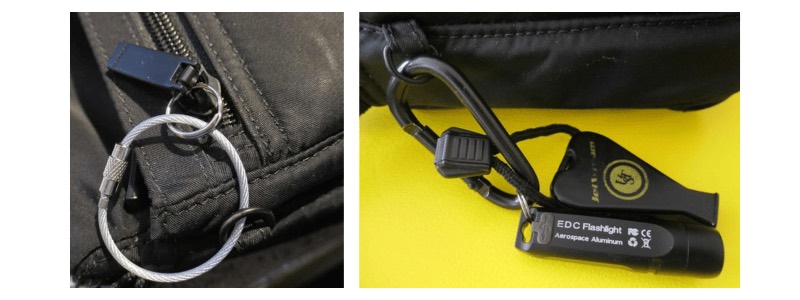
A helpful D-ring is sewn into a side seam, strategically placed by Hedgren for securing the zippers of the two front pockets. I carry nothing of value in these pockets and instead use the D-ring to attach a whistle and a keychain flashlight to a carabiner for quick access. All three are small enough to stow inside the purse, depending on the activity.
3. Improve internal security
The main compartment of the Hedgren Eye has a zippered, almost hidden RFID-protected pocket for items with contactless chips, such as a passport, trusted traveller card, and one or two financial cards. I love this design because the pocket is not easily visible, doesn’t have multiple credit card slots, and requires opening two zippers to access the contents.
Also within the spacious main compartment are two open pockets. After making modifications, I use these for my phone and a slim RFID-blocking wallet. To each pocket, a D-ring has been added (with sewing tape and thread) for tethering the phone and wallet using a short, retractable coil with lobster-claw clasps at both ends. This means that the wallet and the phone remain inside the purse at all times, safely attached to their respective D-rings.
Removing a financial card and returning it to the wallet after use is a habit I’ve come to appreciate. Using the phone while out and about can be accomplished by closing the zipper and keeping it securely tethered to the D-ring.
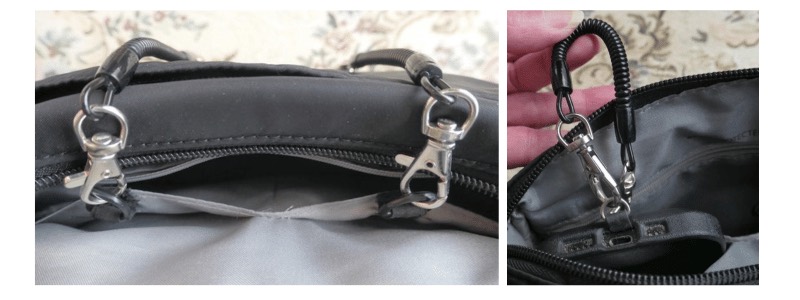
The wallet has a built-in ring for attaching the retractable coil. My phone has a tether tab inside my wallet phone case. It’s unobtrusive and allows for charging without getting in the way of the cable.
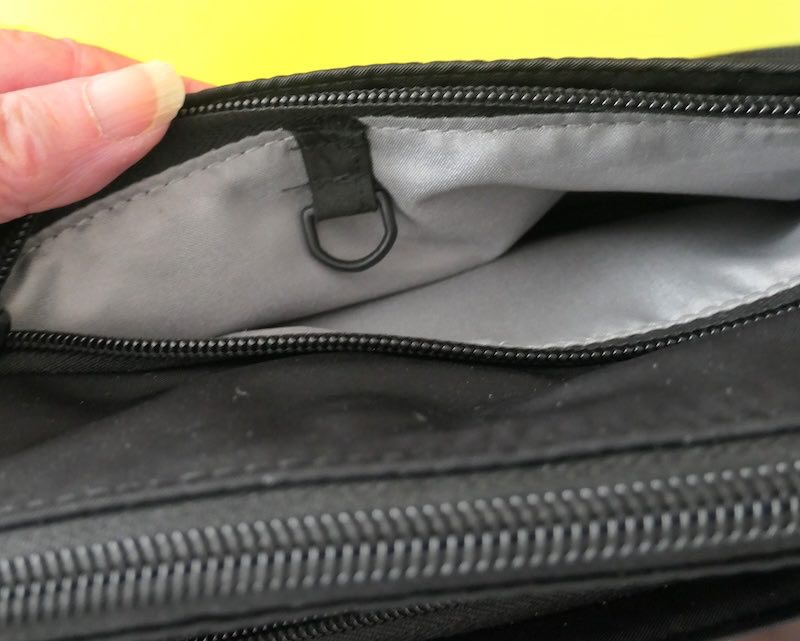
Inside the zippered back pocket, a small plastic D-ring has been attached to the zipper seam with sewing tape and thread. This is for tethering a small pouch for items requiring extra security.
Conclusion
While no bag is 100% theft-proof, some simple modifications can make it less attractive to pickpockets, encouraging them to seek out easier targets. A variety of inexpensive additions can enhance the security of an existing bag without buying a new anti-theft product that might lack the features you’ve come to appreciate in your favourite travel purse.
Might these additional resources be helpful?
- 15 Top tips to protect money and valuables during travel
- 12 Must-have features of a phone wallet case for travel
- Stop pickpockets with an assortment of anti-pickpocket gear
- 17 Effective tips on protection from pickpockets
If you found this post useful, please share it by selecting one or more social media buttons. Do you have any DIY suggestions to make a favourite travel purse more secure? If so, please add your thoughts in the comments. Thank you.
Care to pin for later?
Some of the links in this article are affiliate links meaning that if you click on one and purchase something, you don’t pay more but Packing Light Travel earns a small commission which helps with the costs of maintaining the site. Thank you for your support.



Thank you for these simple security fixes. Very ingenious. I use a cane and need to be hands free so I have been looking for ways to secure my backpack.
Hi Anne
This looks like a great idea and I wish I had the “do it yourself” ability to pull it off. Although I realize this can’t be as complicated as it appears (to me), for an intimidated klutz like me, I am defeated even before I start. All this to say: any chance you could make a video with a step- by-step?
Best wishes for a happy and healthy 2026
Hi Hannah, thank you for reading the post and leaving a comment. Creating a video is outside my area of expertise; unfortunately, the best I can do is describe some options with photographs. If it helps, I don’t attach D-rings to the inside of a purse. For that I rely on someone within the community with a sewing machine and the skills to do a decent job. Locking a zipper depends on how the zipper of the purse or bag is structured, what anchor points exist, and what split rings, clasps, carabiners, cables, or safety pins you have at your disposal to ‘lock’ a zipper to deter pickpockets. Thanks again, and good luck.