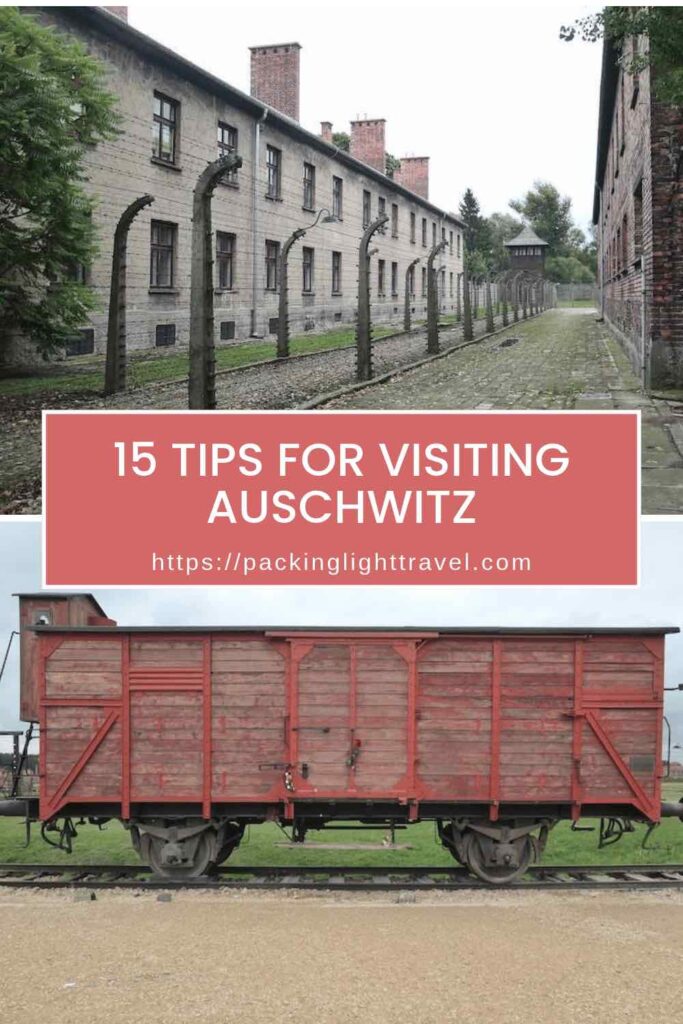
In 2025, the Auschwitz Memorial and Museum attracted 1.95 million people. Due to the overwhelming demand, plan visits as far in advance as possible. If you include the memorial site on your itinerary, consider these tips for visiting Auschwitz.
What is the Auschwitz Memorial and Museum?
The Auschwitz Memorial and Museum was the site of unimaginable horrors in the 1940s. In 1979, it was inscribed as a UNESCO World Heritage Site given its direct association with the atrocities of the Holocaust.
During the Nazi occupation of Poland in World War II, the former military garrison in the town of Oświęcim, 70 kilometres (43.5 miles) from Kraków, was taken over by the Nazis in 1940 and renamed Auschwitz. To the 20 original brick buildings of the Oświęcim barracks, eight were added during the occupation, along with a gas chamber, crematorium, watchtowers, gallows, and electrified fences.
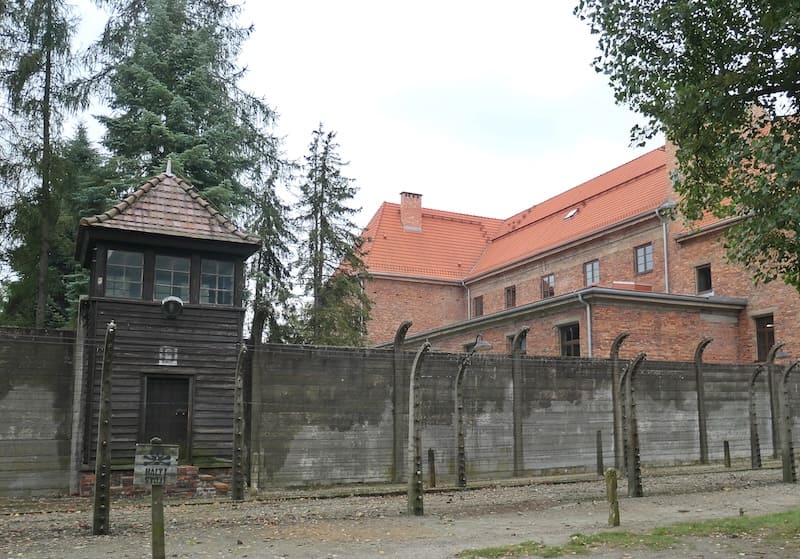
Auschwitz I, the original camp, initially served as a concentration camp for Polish political prisoners. It was relatively small and housed the administrative centre of the entire camp complex. In Auschwitz I, prisoners were subjected to forced labour, medical experiments, and executions.
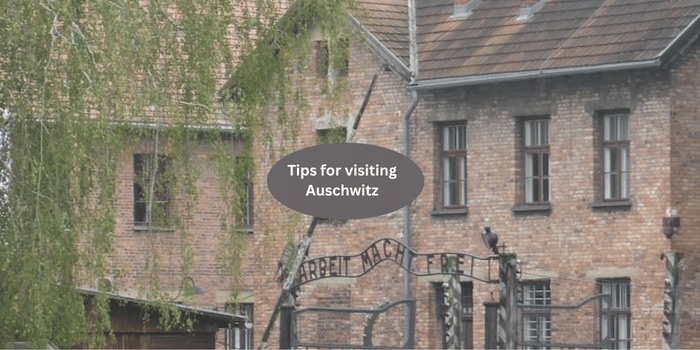
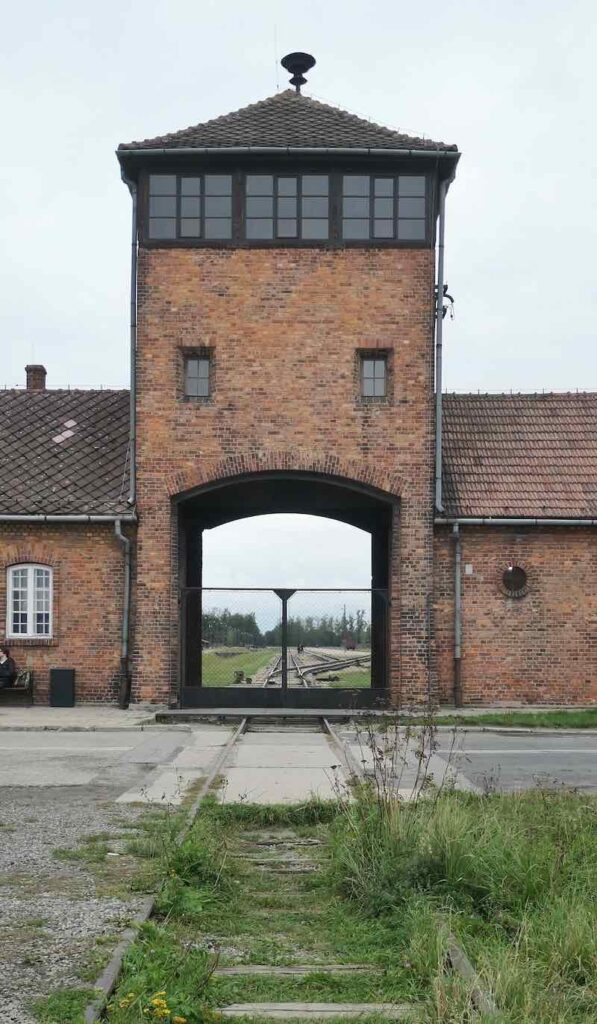
The infamous entrance gate has the inscription “Arbeit macht frei” (“Work sets you free”), a grim symbol of the suffering of prisoners subjected to forced labour.
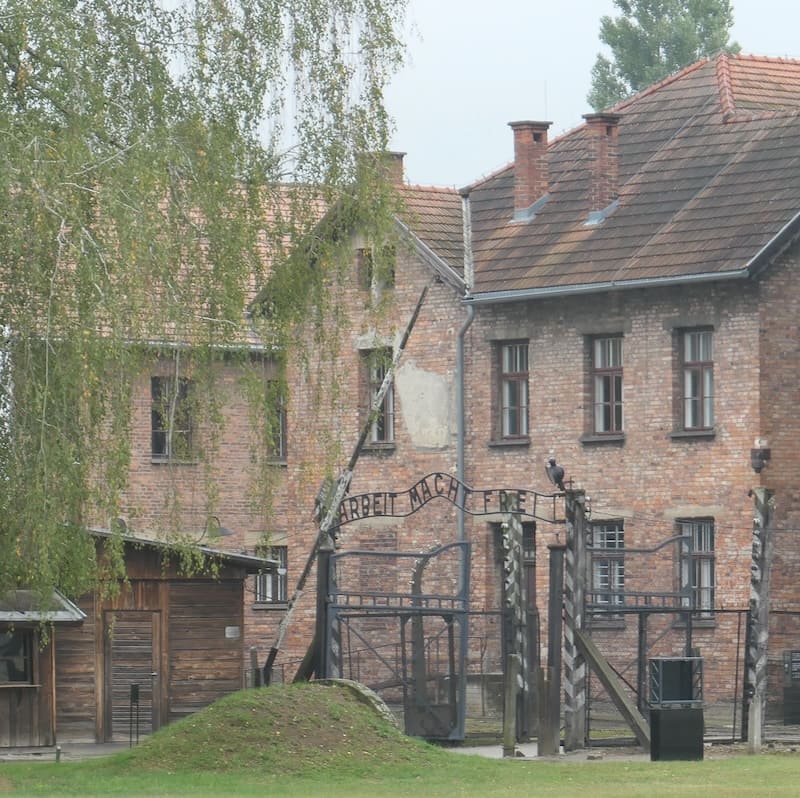
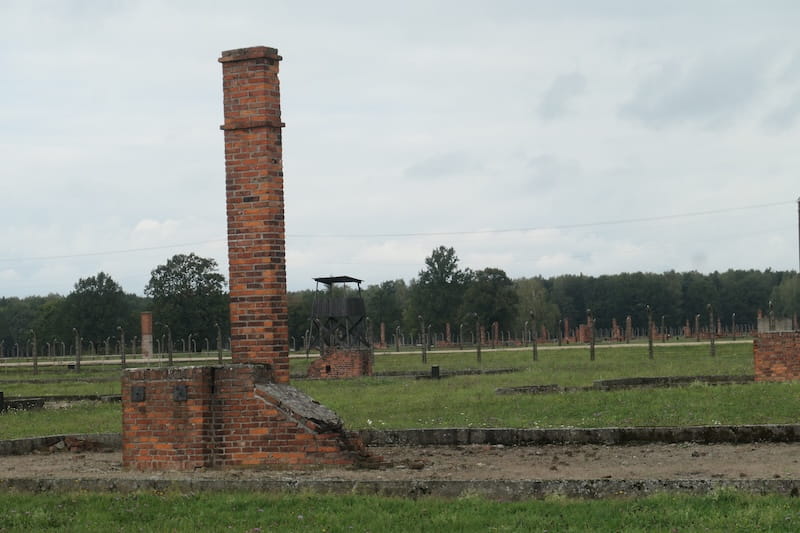
Auschwitz II-Birkenau was built in 1941 a few kilometres from Auschwitz I. It was many times larger, and today, unlike Auschwitz I, much of Birkenau is in ruins. The bricks used to build the initial brick barracks at Birkenau came from the homes of expelled Polish residents of Brzezinka, which sat on the site designated for the new camp. Prisoners forced to build the camp dismantled the houses, farm buildings, and other structures belonging to the expelled families.
Immediately after the war, returning residents dismantled the wooden structures to reuse the wood and building materials to rebuild devastated local homes. This left behind fields of standing brick chimneys.
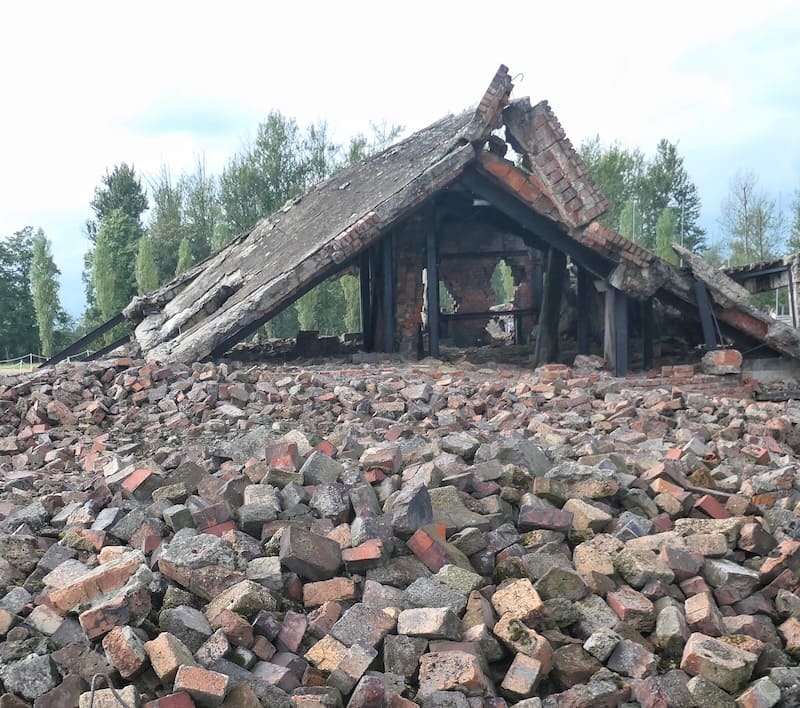
Birkenau became the main extermination camp. It housed the main gas chambers and four crematoria where the mass murder of Jews and other groups took place. As Soviet troops advanced in late 1944, the SS attempted to erase physical proof of the genocide to prevent the approaching Allied and Soviet nations from discovering the scale of the atrocities. Crematoria II, III, and V were blown up with explosives in January 1945 just days before Soviet troops liberated the camp.
The two former camps became notorious for their immense scale and the systematic unfolding of the Holocaust. It’s estimated that 1.1 million people perished at Auschwitz.
Tips for visiting Auschwitz
Based on my research, activity in social media groups where people report booking and cancellation issues, and a visit to the memorial site in September, 2026, I offer the following tips for visiting Auschwitz.
1. Book online at the museum site
It may be tempting to book tickets with hotel pickup through third-party resellers, but it’s a risk not worth taking. There are far too many reports in social media groups regarding changes in pick-up times being moved to very early in the morning and last-minute cancellations. Since March 1, 2026, Auschwitz no longer has a ticket office, and the only reliable source of entry passes is at visit.auschwitz.org.
Each visitor receives a personalised entry card showing their name, date, time, language, and type of booking.
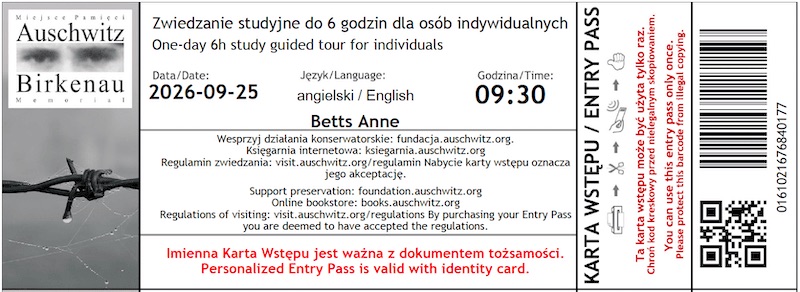
Entry passes are not transferable. Social media groups receive countless requests from people who tried to book too late or had their bookings cancelled and are looking for tickets from people who can no longer use their entry passes.
2. Book as far in advance as possible
The Auschwitz Memorial and Museum is open seven days a week year-round, except on Christmas Day, New Year’s Day, Easter Sunday, and occasionally for official state visits or ceremonies. Based on 2025 statistics, this averages 5,387 visitors per day, with many more during the busiest period from June to August. Booking in advance is essential.
Entry passes are released 90 days in advance. Entry passes for individual visitors are non-changeable and non-refundable.
Tours with an English-speaking guide are the most popular, so spaces are rarely available within a few weeks of a planned visit, especially during the busy periods. You can create an account anytime at visit.auschwitz.org to speed up the purchasing process.
3. Choose your tour
Several tours are available for both groups and individuals.
(i) Online tour
“Auschwitz in Front of Your Eyes” is a two-hour online guided tour of Auschwitz-Birkenau. Reservations can be made through the visit-auschwitz.org system. The guide narrates live, using multimedia materials, archival photographs, artistic works, documents, and survivor testimonies.
(ii) Free entry (without a guide)
Entry to the museum and memorial is free.
Fees are charged for engaging a guide-educator. Visitors in organised groups of more than 10 people require a guide, and individual visitors have the option of joining a guided tour. A guided tour is recommended for the best historical and educational experience.
Free-entry times are limited and subject to the availability of entry passes. Currently, visit.auschwitz.org advertises free-entry times as follows:
- December: from 13.00
- January, November: from 14.00
- February: from 15.00
- March, October: from 16.00
- April to September: from 17:00
Keep in mind the ‘hours of entrance’ and that visitors may stay on site for 90 minutes after the last entrance. For example, visitors may remain on the site until 17:30 in February or 20:30 in July. Currently, visit.auschwitz.org advertises hours-of-entrance times as follows:
- 07:30 – 14:00 December
- 07:30 – 15:00 January, November
- 07:30 – 16:00 February
- 07:30 – 17:00 March, October
- 07:30 – 18:00 April, May, September
- 07:30 – 19:00 June, July, August
(iii) Standard tour
The standard tour lasts about 3.5 hours and starts at Auschwitz I. Group sizes are capped at 30.
You can book a place on a tour at visit.auschwitz.org, where you will find information on available dates and entry pass prices. Concessionary entry passes are available to students up to 26 years old, people aged 75 and older, and people with disabilities.
The price includes a tour of the former Auschwitz I and Auschwitz II-Birkenau camps with a guide-educator, rental of a headset, and transfer between both sites of the former camp. The shuttle bus is intended for individual visitors on guided tours. However, in September 2026, I observed no effort to monitor who was on a guided tour and who wasn’t.
(iv) Study Tour
The study tour lasts approximately 6 hours and starts at Auschwitz I. Groups are smaller, with a maximum of 20 people, and more sites are visited at both locations.
Study tours are conducted every day in Polish (09:00), German (09:15), and English (09:30).
4. Examine your transportation options
Auschwitz is in the town of Oświęcim, 70 kilometres (43.5 miles) from Kraków. Public transportation options include trains and buses.
The Lajkonik bus ride from Kraków MDA Bus Station takes about 85 minutes. As many as 12 buses run each day, with the final destination being Oświęcim Muzeum Auschwitz, where it stops outside the gates.
For train travel, take the train from Kraków Central Station (Kraków Główny) to Oświęcim station. Travel time is between 40 minutes and 1 hour 40 minutes, depending on the service (Intercity vs local). The Intercity (IC) train takes between 40 and 45 minutes. If returning by train, tickets can be purchased on the train from conductors. Oświęcim train station is 1,500 metres from the museum’s main entrance.
Ride-sharing services are also available. In September 2026, we pre-booked an Uber for 07:30 (for a 9:30 start to our study tour). The early morning forecast predicted rain, so taking an Uber with door-to-door pick-up and drop-off saved a wet walk (or ride-sharing options and possible delays) to and from the train stations. The cost was PLN 207.57 (including a tip of PLN 10) which amounted to CAD 73.94, USD 52.78, and GBP 39.49 split between two people. The journey took 75 minutes.
5. Download the KOLEO and FlixBus apps
The KOLEO app posts train schedules, prices, and travel times to the destination. Purchasing tickets through the app is also possible.
The FlixBus app has bus schedules, prices, and travel times to the destination. It also shows sold-out bus departures, so book as early as possible.
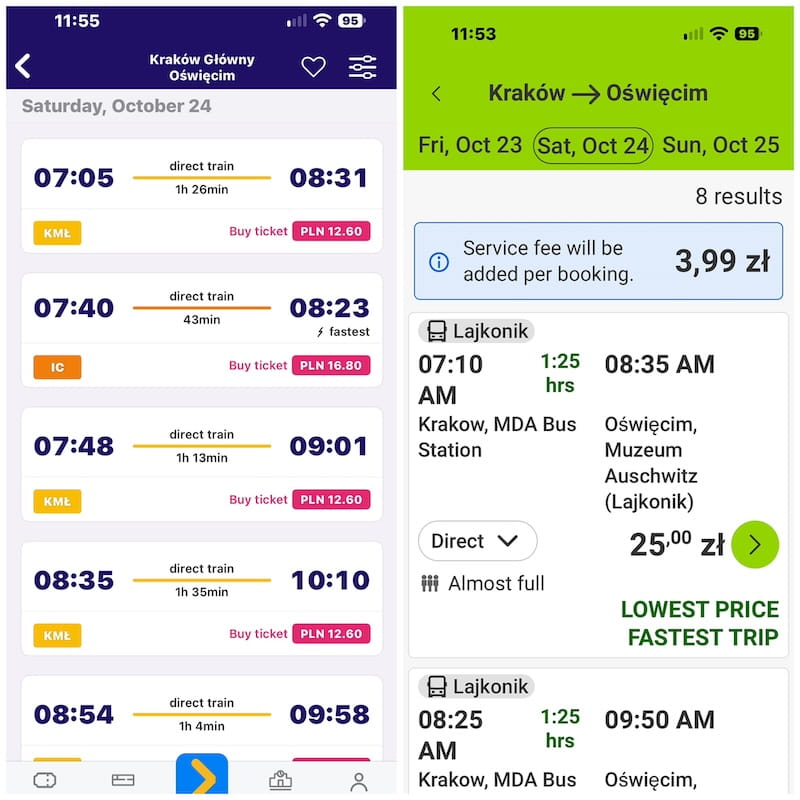 KOLEO FlixBus
6. Arrive at least 30 minutes in advance
Thirty minutes is required for security screening. At the entrance to Auschwitz I, all visitors pass through metal detectors, and bags go through X-ray scanners.
We arrived at 08:45 for our 09:30 tour, and were invited to return at 09:00, 30 minutes before our tour started. This allowed us to visit the café near the main entrance for coffee, a snack, and a bathroom break.
Our entry passes indicated a study tour booking, so we were directed to a booth to collect stickers to attach to our clothing.
7. Bring a photo ID
Security staff check your government-issued ID (such as a passport or driver’s licence) to ensure the name matches the name on your entry pass.
8. Limit the size of your bag
The maximum size of bags and backpacks allowed onto the museum grounds is 35 x 25 x 15 centimetres (14 x 10 x 6 inches).
Paid luggage storage is available for larger bags. The dimensions of the luggage storage lockers, expressed in centimetres, are 90 x 50 x 22, 60 x 50 x 22, and 85 x 65 x 42. The internal dimensions are 90 x 50 x 30, 60 x 50 x 30, and 90 x 65 x 50. Their maximum load is 30 kilograms.
9. Plan for a short break between tours
Auschwitz II-Birkenau is 3.5 kilometres from Auschwitz I. The free museum shuttle transfers visitors between the two former camps. It departs every 12 minutes, with an approximate ride time of 8 minutes.
Our educator-guide suggested a 15-minute break, which was barely enough time to visit the toilet and grab a snack. There was a long queue for the women’s facilities, and I noticed a long line at the vending machine. Visiting the café near the main entrance wasn’t really an option given the limited break time.
10. Pack a snack
Consuming food (or smoking) while visiting Auschwitz I or Auschwitz II-Birkenau is prohibited. Carrying water is permissible.
Visitors typically consume packed snacks or sandwiches during the break outside the main memorial perimeter while waiting for the shuttle. I had purchased a few energy bars in Kraków. They transported well in my daypack and were easy to access while waiting for the shuttle outside the main entrance.
11. Photography is allowed, with limits
Recording and taking photographs in buildings using a flash or a tripod isn’t allowed.
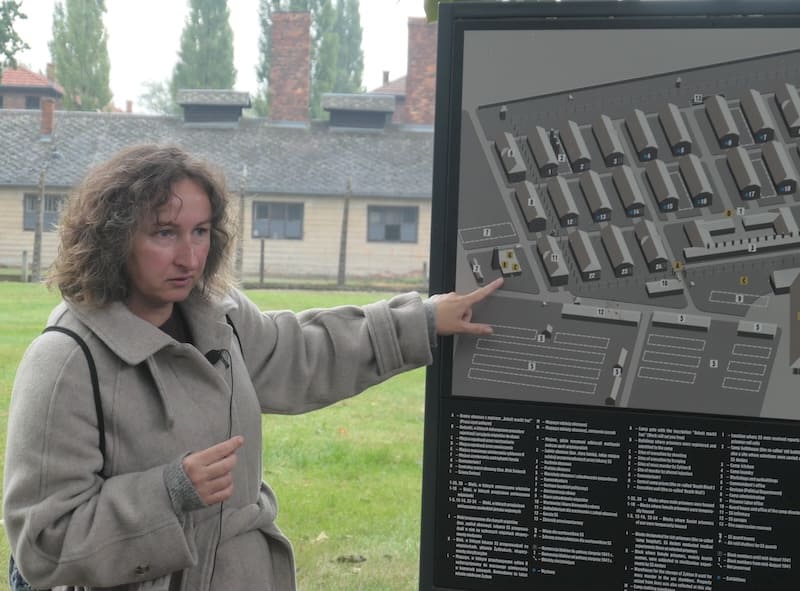
Recording and taking photographs in certain buildings isn’t permitted, and the educator-guide will share which ones before entry. Signs also indicate where photographs aren’t allowed. For example, Block 4 Room 5 at Auschwitz I has an exhibit displaying two tons of hair cut from 40,000 murdered victims. The hair is considered human remains, and taking photographs as disrespectful.
Recording and taking photographs of security checkpoints and other elements of the security systems aren’t permitted. Recording the guide-educator’s commentary is also not allowed. As a matter of courtesy, ask the guide-educator if they mind having their photograph taken during the tour.
12. Dress for the weather
Most of the time, visitors are on their feet for several hours, so sturdy, comfortable walking shoes with a decent tread are essential. Auschwitz I has many steps, and there are cobblestones, gravel, dirt tracks, and uneven ground at both locations. Auschwitz II-Birkenau is mostly open with few buildings and minimal tree cover or shelter.
Summer can be very hot, so sun protection, a hat, and a bottle of water will be invaluable. In spring, autumn, and winter, pack warm layers, windproof, waterproof rainwear, and perhaps a compact umbrella.
13. The tour ends at Auschwitz II-Birkenau
Our six-hour study tour ended at the ruins of Crematorium V. Our group wandered back to the entrance where the guide-educator didn’t escort anyone out. So it was possible to linger at Auschwitz II-Birkenau to take last-minute photographs, visit the on-site bookstore, and take the shuttle back to the entrance at Auschwitz I.
14. Download the Bolt and Uber apps
After spending over six hours on our feet, we had limited energy to walk the 1,500 metres to the Oświęcim station. My Pedometer app indicated I’d walked 20,139 steps or 11.8 kilometres (7.3 miles), including a 20-minute walk from Kraków Central Station to our accommodation. I was thankful to have the KOLEO app to show the next departure for Kraków, and the Bolt app to book a ride. Several ride-sharing vehicles were on standby in the main visitor parking lot and entrance zone located at 55 Więźniów Oświęcimia Street. The Bolt ride cost PLN 13.72 (CAD 4.89, USD 3.49, or GBP 2.61) split between two people.
15. Research Nazi oppression and the Holocaust in advance
A visit to the Auschwitz Memorial and Museum is an emotionally draining experience.
My first visit to Auschwitz-Birkenau was in 1973, when Europe was divided, and Poland was part of the Eastern Bloc from the end of World War II until 1991. As such, the country attracted very few visitors. The exhibits were limited and sparse, yet my self-guided tour pushed emotional buttons and boundaries. The sombre, moving experience was one of the highlights of my youthful travels that left an abiding memory for decades to come.
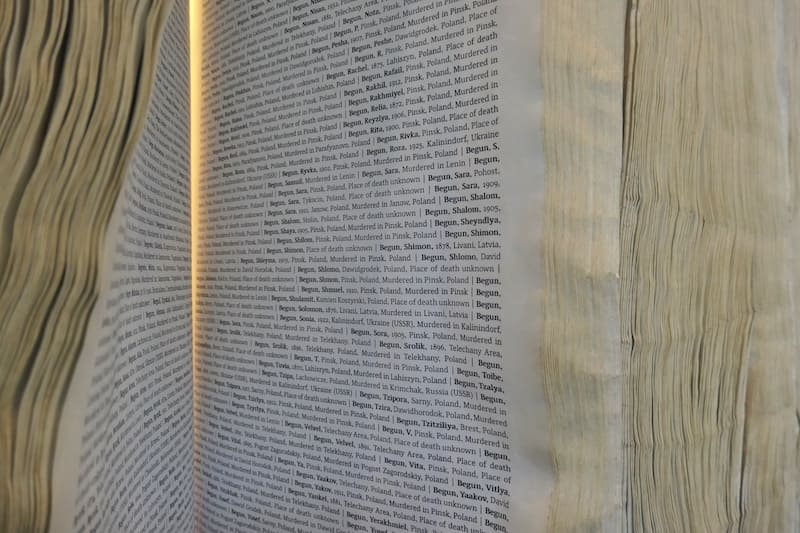
On my second visit in 2026, I wasn’t surprised by the number of people interested in deepening their understanding of the kind of extremism and hatred that led to such atrocities. 53 years later, I benefited from the important work of archivists, historians, and other activists whose efforts created a more detailed and memorable experience than my 1973 visit. There were many examples, including The Book of Names, a rotating-page exhibit with the individual identities of approximately 4.8 million Jewish Holocaust victims. It was installed in 2013.
In preparation for my 2026 visit, learning as much as possible about the Holocaust, Auschwitz-Birkenau, the rise of Nazi extremism, and the key events leading to World War II became a priority. It led to a deeper understanding of the sheer scope of the Nazi commitment to the “Final Solution” and how unimaginable the horrors of Auschwitz were.
Here are some suggestions on books/audiobooks and podcasts with a focus on Auschwitz-Birkenau:
- The Tattooist of Auschwitz by Heather Morris
- The Dressmakers of Auschwitz by Lucy Adlington
- The Ballerina of Auschwitz by Edith Eva Eger
- The Librarian of Auschwitz by Antonio Iturbe
- The Holocaust: Killing Squads, Ghettos, and Gas Chambers (History That Doesn’t Suck podcast)
- The Holocaust: Anne Frank, the Warsaw Ghetto Uprising, and Auschwitz (History That Doesn’t Suck podcast)
- A History of Auschwitz (Dan Snow’s History Hit podcast)
These resources, and more, were invaluable. Despite having a better understanding of the extent of the genocide, there were many moments during the tour when I experienced sadness, revulsion, and anger at its immense scale.
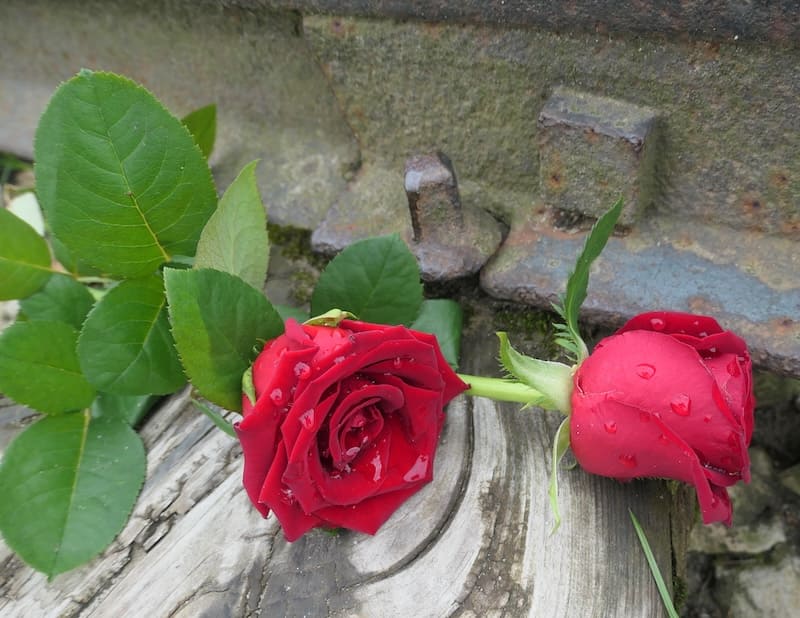
However, one of my most moving experiences was seeing the roses left beside the train tracks at Auschwitz-Birkenau, deeply personal acts of commemoration left by visitors, survivors, or families. The roses were near the spot where thousands last saw their loved ones before the selection process, violently torn apart as the majority were immediately sent to the gas chambers. The stark contrast of a bright red rose against the cold iron, aging wooden ties, and gravel of the death camp was a powerful symbol of life in a place that was built for mass slaughter. It evoked a profound emotional impact.
If you found this post helpful, please share it by selecting one or more social media buttons. Have you visited Auschwitz-Birkenau? If so, what other insights or tips come to mind?
If you’re planning a trip to Poland, might you be interested in 25 Best budget-friendly things to do in Gdansk Poland?
Care to pin it for later?